

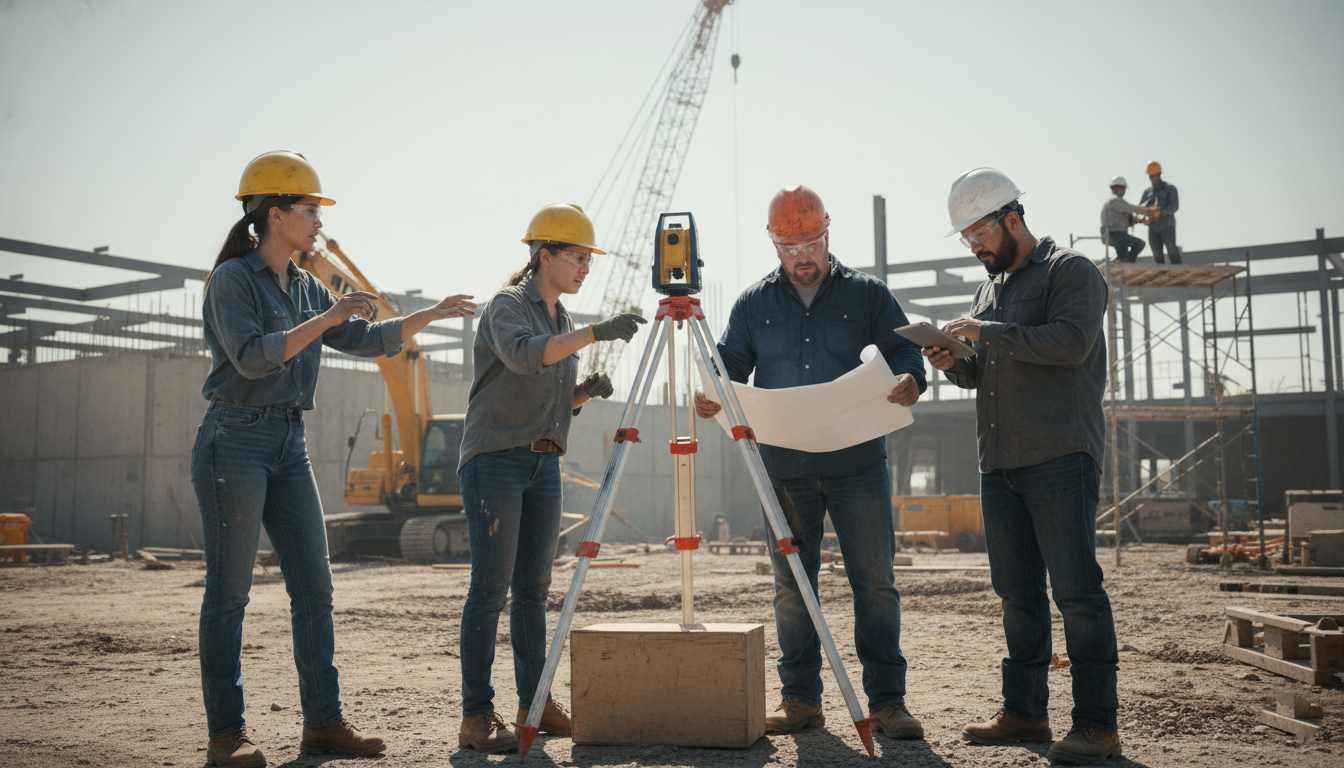
What platform helps reduce time-to-hire in construction?
The U.S. construction industry is facing a hiring crisis that directly impacts project timelines, costs, and productivity. With over 8 million workers employed and demand continuing to rise, contractors are under constant pressure to find skilled labor quickly. However, the real challenge is not just labor shortage—it is access to the right workers at the right time.
This is where a modern Construction Hiring Platform becomes critical. Traditional hiring methods—job boards, staffing agencies, and manual recruiting—are too slow and inefficient for today’s fast-moving construction environment. Projects cannot afford weeks of delays just to fill essential roles like electricians, welders, or equipment operators.
To stay competitive, companies are actively searching for:
fast hiring solutions for construction companies
AI hiring platform for construction workers
best construction staffing solutions
ways to reduce time to hire construction
In this article, we will explore how modern platforms—especially AI-driven solutions like Skillit—are transforming construction hiring in the United States.
Why traditional construction hiring is slow and inefficient
Before understanding the best platform for construction hiring, it’s important to examine why hiring delays happen in the first place.
Lack of visibility into skilled workers
One of the biggest challenges in construction hiring is that most skilled workers are not easily discoverable through traditional channels. According to industry insights, 19 out of 20 craft workers are not missing—they are just hard to find using generic job platforms.
This lack of visibility leads to:
Delayed candidate discovery
Over-reliance on referrals
Limited access to qualified talent
Generic job platforms don’t fit construction needs
Most job boards are built for white-collar roles, not skilled trades. They fail to capture critical data such as:
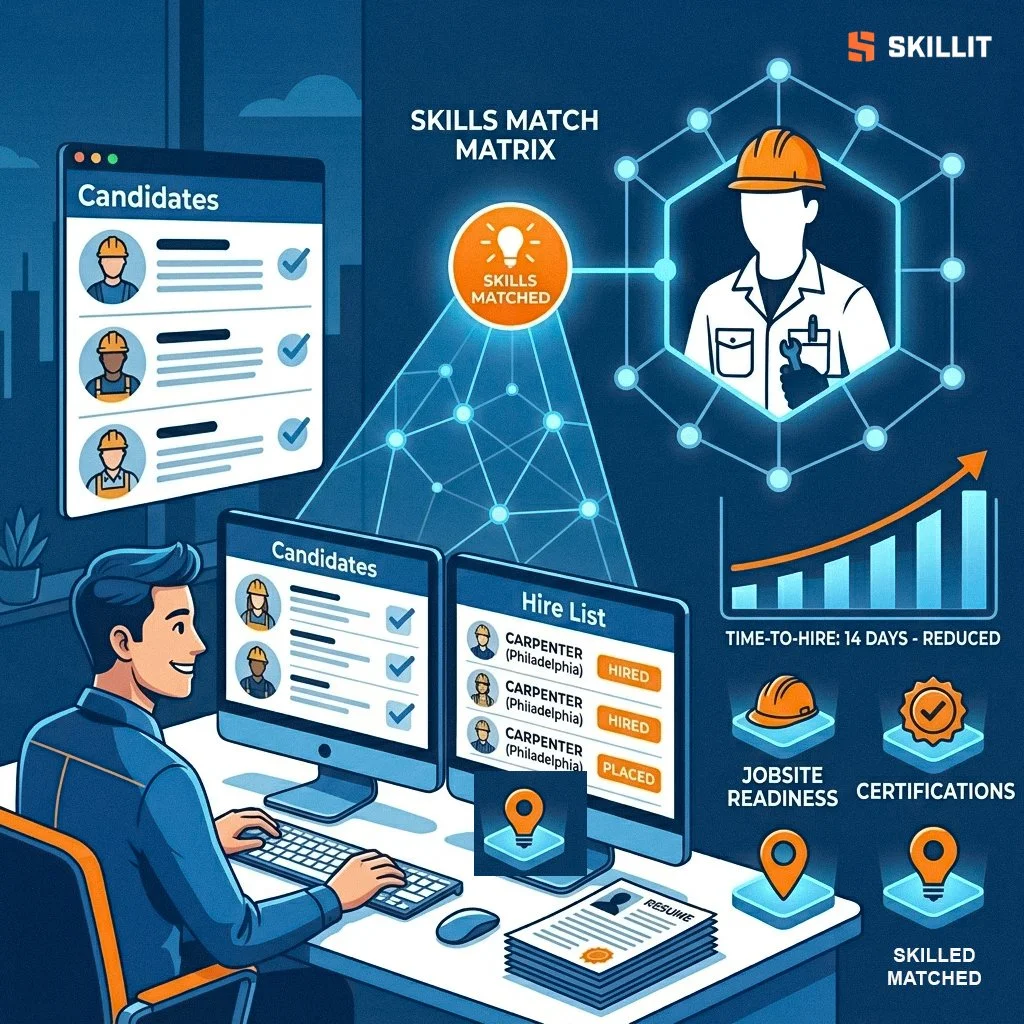
Trade-specific experience
Certifications
Jobsite readiness
Travel and relocation preferences
As a result, recruiters spend excessive time screening unqualified applicants.
Manual processes slow everything down
Traditional hiring involves:
Posting jobs
Waiting for applications
Screening resumes
Scheduling interviews manually
Each step adds delays, making quick hiring for construction workers nearly impossible.
Why reducing time-to-hire inconstruction is critical
In most industries, slow hiring is a problem. In construction, it is a risk. Projects are tightly scheduled. Crews are interdependent. If even one role remains unfilled, it can delay the entire workflow.
The U.S. construction industry employs over 8 million workers, yet demand continues to exceed supply. At the same time, hundreds of thousands of additional workers are needed every year to meet project demand.
Several factors contribute to this:
Aging workforce nearing retirement
Fewer young workers entering skilled trades
Growth in infrastructure and commercial projects
Limited visibility into available skilled workers
Most importantly, many skilled workers exist but are simply hard to find using traditional hiring tools.
The real cost of slow hiring
When companies fail to reduce time to hire construction, the consequences compound quickly.
| Area | Impact of Slow Hiring |
|---|---|
| Project delivery | Missed deadlines and penalties |
| Labor costs | Increased overtime and subcontracting |
| Productivity | Inefficient crew utilization |
| Safety | Overworked workers increase risk |
| Reputation | Loss of client trust |
For example, if a contractor cannot hire electricians on time, it delays every downstream activity, from inspections to finishing work. This is why hiring speed has become a competitive advantage.
To solve these challenges, companies are turning to specialized digital solutions.
| Feature | Traditional Job Boards | Modern Construction Hiring Platform |
|---|---|---|
| Industry focus | General | Construction-specific |
| Candidate quality | Mixed | Pre-vetted |
| Speed | Slow | Fast |
| Matching | Manual | AI-driven |
| Hiring workflow | Fragmented | Integrated |
A Construction job Platform is a specialized digital solution designed specifically for hiring skilled trade workers in the construction industry.
Unlike generic platforms, these systems are built around:
Trade-specific hiring workflows
Skill-based filtering
Real-time worker availability
Faster communication and scheduling
Key characteristics of a modern construction hiring platform
What is a construction hiring platform?
The shift from traditional hiring to specialized platforms is essential for companies looking to reduce time to hire construction
The rise of AI hiring platforms for construction workers

Artificial intelligence is now playing a major role in hiring. An AI hiring platform for construction workers helps companies:
Match candidates based on skills and experience
Automate repetitive tasks
Improve response rates
Reduce manual workload
Instead of replacing recruiters, AI supports them by handling time-consuming processes.
Key features that define the best construction staffing solutions
Not all platforms deliver the same results. The best construction staffing solutions are designed to help companies reduce time to hire in construction while maintaining quality and efficiency.
Trade-specific search
A reliable construction job platform should understand different trades and roles. It must allow filtering by skills, certifications, and experience so recruiters can quickly find the right candidates without sorting through irrelevant profiles.
AI-driven automation
An AI hiring platform for construction workers uses automation to match candidates to jobs and reduce repetitive tasks. This speeds up the process and supports fast hiring solutions for construction companies.
Verified worker profiles
Pre-vetted workers with verified skills and experience make hiring faster and more reliable. This reduces manual screening and helps companies make confident decisions in less time.
Real-time communication
Built-in communication tools help recruiters and workers connect quickly. Faster updates and scheduling lead to quick hiring for construction workers.
Scalability
The platform should handle both small and large hiring needs. This flexibility allows companies to scale their workforce without delays as project demands change.
Together, these features create a hiring system that is faster, more accurate, and easier to manage. Companies that invest in the right platform are better equipped to handle labor shortages, meet deadlines, and stay competitive in today’s construction market.
The platform should handle both small and large hiring needs. This flexibility allows companies to scale their workforce without delays as project demands change.
Together, these features create a hiring system that is faster, more accurate, and easier to manage. Companies that invest in the right platform are better equipped to handle labor shortages, meet deadlines, and stay competitive in today’s construction market.
Skillit: a modern construction hiring platform built for the U.S.
One of the most recognized platforms in this space is Skillit. Skillit is designed specifically to help U.S. construction companies hire faster and more efficiently.
What makes Skillit different
Skillit focuses on solving one core problem: Access to skilled labor, not just labor availability. Many workers exist, but they are difficult to find using traditional tools.
Skillit addresses this by providing:
A large database of vetted craft workers
AI-powered hiring tools
Trade-specific search capabilities
Real-time hiring workflows
Key platform capabilities
Skillit offers several features that directly support fast hiring solutions for construction companies:
| Feature | Description |
|---|---|
| Vetted worker database | Access to thousands of skilled workers |
| Trade-specific filters | Find exact skills and experience |
| AI scheduling | Automates interviews and follow-ups |
| Real-time search | Immediate access to candidates |
| Collaboration tools | Team-based hiring workflows |
Scale and reach
Skillit provides access to:
Over 180,000 vetted workers
More than 35 skilled trades
Workers across hundreds of U.S. markets
This scale is critical for companies that need to hire quickly across multiple locations.
Reducing hiring time in construction is not about rushing decisions. It is about removing friction from every step of the hiring process. The companies that succeed today follow a structured approach built around speed, visibility, and automation.
How to speed up hiring in construction industry (practical framework)
1. Build continuous access to skilled workers
One of the biggest mistakes construction companies make is hiring only when a project begins.
This reactive approach creates delays because:
There is no existing talent pipeline
Recruiters start from zero
Urgency leads to poor decisions
Instead, companies need continuous access to skilled workers.
A construction hiring platform like Skillit solves this by providing:
Ongoing access to active workers
Visibility into availability
A ready-to-use talent pool
This approach turns hiring from reactive to proactive.
2. Shift from job postings to direct sourcing
Traditional hiring depends heavily on job postings. But this method is slow by design.
Steps involved:
Create job description
Publish listing
Wait for applications
Screen candidates
Each step adds time. Modern platforms eliminate this process entirely.
With a construction job platform, you can:
Search workers directly
Filter by trade and experience
Reach out immediately
This is one of the most effective ways to reduce time to hire construction roles.
3. Use AI to automate hiring workflows
Recruiters spend a significant amount of time on tasks that do not require human judgment.
These include:
Scheduling interviews
Sending reminders
Following up with candidates
An AI hiring platform for construction workers automates these tasks.
For example, Skillit’s AI assistant:
Contacts candidates automatically
Schedules interviews in real time
Handles rescheduling
This reduces delays and increases efficiency.
4. Focus on high-quality, job-ready candidates
Speed is not just about moving faster. It is about avoiding slowdowns. One of the biggest slowdowns is dealing with unqualified candidates.
Traditional platforms often produce:
High application volume
Low relevance
Skillit solves this by providing:
Vetted worker profiles
Verified skills and experience
Structured candidate data
This allows recruiters to focus only on candidates who are ready to work.
5. Centralize hiring into one platform
Many companies use multiple tools:
Job boards
Spreadsheets
Email threads
Scheduling apps
This fragmentation slows everything down.
A single construction hiring platform centalizes:
Candidate search
Communication
Scheduling
Collaboration
This creates a faster and more streamlined hiring process.
How Skillit helps reduce time-to-hire in construction
1. Eliminates waiting for applicants
Traditional hiring depends on candidates applying. Skillit removes this step completely.
Recruiters can:
Search for workers instantly
View profiles in seconds
Start outreach immediately
This alone can cut hiring time significantly.
2. Provides job-ready workers
Skillit focuses on connecting companies with workers who are ready to work.
This includes:
Verified skills
Relevant experience
Availability for work
This reduces time spent screening and increases hiring confidence.
3. Automates scheduling and communication
Scheduling interviews is one of the biggest delays in hiring.
Skillit’s AI assistant automates:
Calls
Scheduling
Reminders
This ensures faster coordination between recruiters and workers.
4. Improves matching accuracy
Skillit uses structured data to match workers with jobs based on:
Skills
Location
Pay expectations
Experience
Better matches mean fewer delays and faster decisions.
How Skillit enables real-world fast hiring workflows in construction
Understanding theory is useful, but what truly matters is how a Construction Hiring Platform performs in real hiring scenarios. In the U.S. construction industry, speed is everything—projects operate on tight schedules, and even a few days of delay in hiring can result in significant cost overruns.
Skillit is designed to streamline every stage of the hiring funnel, transforming a traditionally slow process into a fast, predictable workflow.
Step-by-step hiring workflow using Skillit
Below is how a typical hiring process works using a modern Construction job Platform like Skillit:
| Step | Traditional Hiring Process | Skillit Workflow |
|---|---|---|
| Candidate sourcing | Post job and wait | Instantly search 180K+ workers |
| Screening | Manual resume review | Filter by skills, certifications |
| Outreach | Calls & emails | AI-driven automated outreach |
| Scheduling | Back-and-forth communication | AI schedules instantly |
| Hiring decision | Delayed | Real-time decision-making |
Key takeaway
Instead of waiting days or weeks, companies can reduce time to hire construction roles to just a few days—or even hours in urgent cases.
Advanced use cases of construction hiring platforms
To fully understand the value of a construction job platform, it helps to look at real-world applications.
Use case 1: Scaling workforce across multiple sites
A contractor working on multiple projects may need to hire:
Electricians in Texas
Welders in California
Laborers in Florida
Using traditional methods, this would require:
Multiple job postings
Separate hiring processes
With Skillit, recruiters can:
Search across locations
Filter by availability
Manage hiring in one place
Use case 2: Filling urgent roles
When a project falls behind schedule, hiring becomes urgent.
Skillit enables:
Immediate candidate search
Instant outreach
Faster interview scheduling
This makes it one of the most effective tools for quick hiring for construction workers.
Use case 3: Hiring specialized trades
Certain roles are difficult to fill, such as:
Industrial electricians
Pipe welders
Millwrights
Skillit’s specialized database makes it easier to find these workers compared to generic platforms.
Trade-specific hiring: why specialization matters
Construction roles are highly specialized. Hiring a welder is not the same as hiring a carpenter or electrician. Each role requires:
Different certifications
Different tools and experience
Different safety requirements
Skillit’s trade-specific approach
Skillit supports over 35 trades, including:
Electricians
Welders
Plumbers
Carpenters
Heavy equipment operators
Concrete workers
Each worker profile includes structured data such as:
Verified skills
Work history
Certifications
Pay expectations
Location and travel preferences
This level of detail ensures recruiters connect only with relevant candidates, enabling quick hiring for construction workers.
Eliminating hiring bottlenecks with AI automation
Common hiring bottlenecks
Traditional hiring is slowed down by:
Delayed candidate responses
Missed calls and scheduling conflicts
Manual follow-ups
Administrative workload
How Skillit solves these problems
Skillit’s AI assistant automates:
Candidate outreach via text and phone
Interview scheduling
Follow-ups and reminders
This ensures:
Faster communication
Higher response rates
Reduced recruiter workload
As a result, companies can achieve quick hiring for construction workers without increasing HR resources.
One of the biggest advantages of fast hiring solutions for construction companies is automation.
The ROI of using a construction hiring platform
For U.S. construction companies, adopting a modern Construction Hiring Platform is not just about speed—it’s about measurable return on investment.
Hiring delays directly impact:
Project timelines
Labor costs
Client satisfaction
Overall profitability
When companies fail to fill roles quickly, they often face:
Overtime expenses
Project penalties
Reduced productivity
How Skillit delivers ROI
Reduced time-to-hire:
Skillit enables instant access to pre-vetted workers and uses automation to streamline hiring workflows. This allows companies to reduce time to hire construction roles from weeks to just a few days, helping projects start on schedule and avoid costly delays.
Lower cost-per-hire:
By reducing manual effort and reliance on traditional sourcing methods, Skillit helps cut overall hiring costs. Companies save on recruiter hours, job advertising expenses, and third-party agency fees, making it one of the most cost-effective fast hiring solutions for construction companies.
Higher worker productivity:
Skillit connects companies with workers who are already pre-vetted, skill-matched, and job-ready. This means new hires can contribute immediately, leading to better on-site performance and improved team efficiency from day one.
Improved retention:
Better matching between workers and roles leads to higher job satisfaction. This results in lower turnover, fewer disruptions, and reduced rehiring costs, which are critical for maintaining long-term project stability.
Skillit helps construction companies improve hiring outcomes by focusing on speed, efficiency, and workforce quality. As a modern construction hiring platform, it is designed to deliver measurable return on investment across every stage of the hiring process.
By improving hiring speed, reducing costs, and increasing workforce quality, Skillit delivers consistent value across projects. Companies using the platform are better positioned to scale efficiently and stay competitive in the construction industry.
Future of construction hiring in the United States
1. AI-first hiring infrastructure
Platforms like Skillit are leading a shift toward:
Fully automated hiring workflows
Intelligent candidate matching
Predictive hiring insights
This is redefining what a Construction job Platform looks like.
2. Skills-based hiring replacing resumes
Traditional resumes are becoming obsolete in construction hiring.
Instead, platforms now focus on:
Verified skills
Real project experience
Trade-specific data
This ensures better hiring decisions and faster onboarding.
3. Real-time labor marketplaces
The future of hiring is real-time.
Companies will:
Access workers instantly
Fill roles on-demand
Scale teams dynamically
This model is essential for achieving fast hiring solutions for construction companies.
4. Increased focus on workforce accessibility
The biggest challenge is no longer just labor shortage—it’s access.
Modern platforms solve this by:
Digitizing the workforce
Making workers discoverable
Enabling instant connections
The construction industry is undergoing a digital transformation, and hiring is at the center of it. Key trends shaping the future
Why Skillit is considered the best platform for construction hiring
When evaluating the best platform for construction hiring, several factors matter:
| Factor | Why it matters |
|---|---|
| Speed | Faster hiring reduces project delays |
| Accuracy | Better matches improve productivity |
| Scalability | Ability to hire at volume |
| Cost efficiency | Lower hiring costs |
Skillit performs strongly across all of these areas.
The construction industry can no longer rely on slow, outdated hiring methods. With growing demand and ongoing labor challenges, speed and accuracy in hiring have become critical.
A modern construction hiring platform powered by AI is the most effective way to reduce delays, improve workforce quality, and stay competitive.
Platforms like Skillit help companies:
Reduce time to hire construction roles
Access skilled, job-ready workers faster
Improve hiring efficiency at scale
Deliver projects on time and within budget
For companies looking for fast hiring solutions for construction companies, the best construction staffing solutions, or quick hiring for construction workers, adopting an AI-driven platform like Skillit is the most practical path forward.
Conclusion
FAQs
How quickly can I hire workers using Skillit?
Most companies can fill roles within a few days, depending on job requirements and location.
How quickly can I hire workers using Skillit?
Most companies can fill roles within a few days, depending on job requirements and location.
How does Skillit ensure candidate quality?
Through skill verification, experience checks, and AI-based matching to ensure candidates meet job requirements.
Can Skillit handle high-volume hiring?
Yes, Skillit is built to scale and can support both single hires and large workforce demands.
Why should construction companies switch to Skillit?
Because it delivers faster hiring, better-quality workers, reduced costs, and improved overall project outcomes.
Is Skillit easy to integrate into existing hiring processes?
Yes, it is designed to fit seamlessly into existing workflows with minimal disruption.
Skillit connects craft workers with construction companies for great job opportunities
Build a complete profile and be found by top construction companies today.