

First Aid and CPR Certification for Construction Workers: What Contractors Are Requiring in 2026
Quick Answer
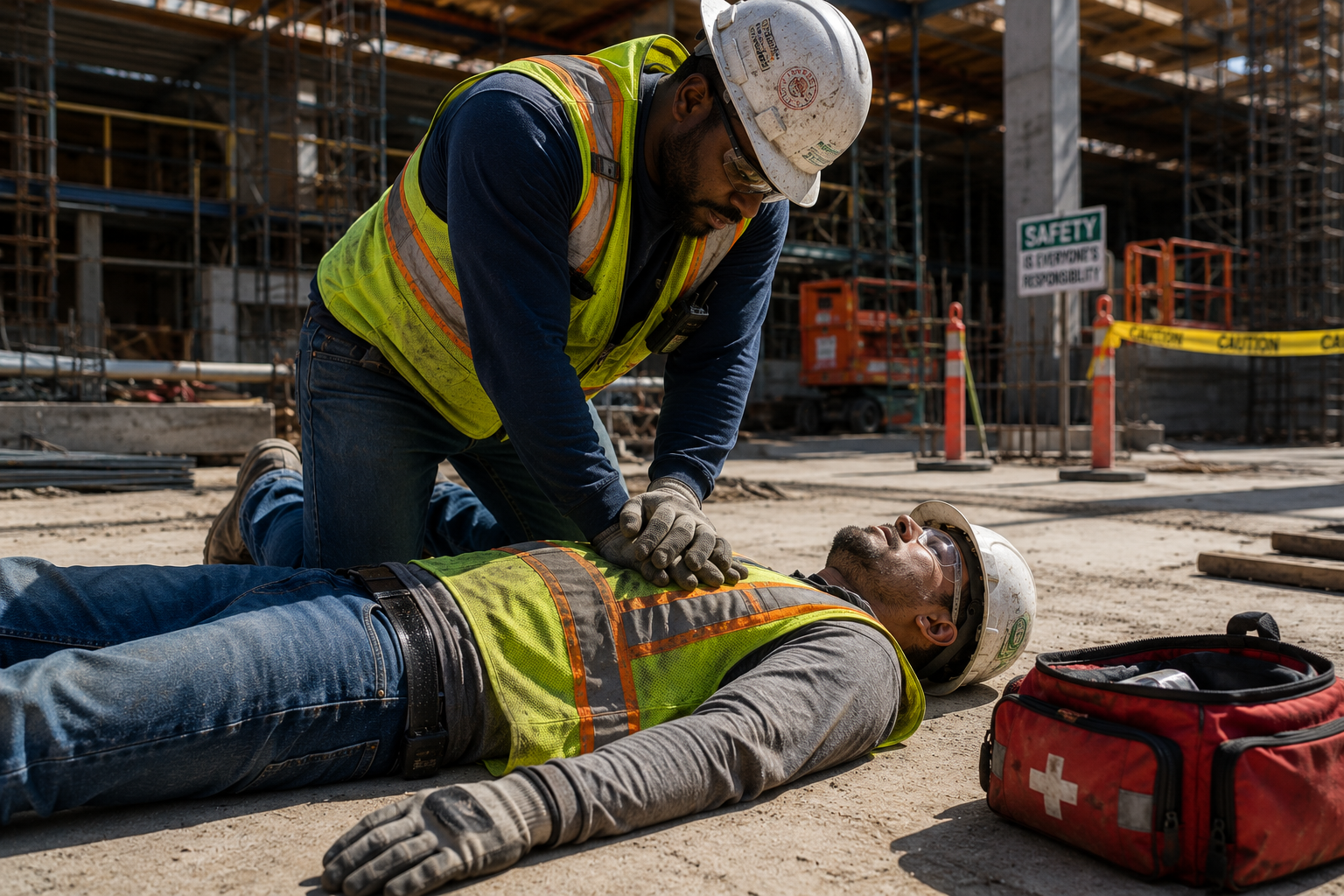
More contractors in commercial, industrial, and civil construction are requiring first aid and CPR certification before workers can mobilize, not just recommending it. A standard two-year card typically costs $50–$100 and takes four to eight hours to earn. In tight labor markets, having a current card on file can tip a hiring decision in your favor and, for workers moving into lead roles, it is increasingly a hard requirement rather than a soft preference.
Why Contractors Are Adding First Aid and CPR to Their Hiring Checklists
The push is coming from multiple directions at once. Owner-clients — the companies actually paying for construction — are writing first aid and CPR requirements into their project bid packages. GCs pass those requirements down to subs. Subs respond by making the cert a condition of employment before the first day on site.
Fact: OSHA 29 CFR 1926.50 requires contractors to ensure first aid is available and in areas where a hospital or clinic is not reasonably accessible, at least one person with current first aid training must be on every crew.
Three other forces are accelerating the trend. First, data-center, renewable energy, and large industrial projects often operate under corporate safety programs that are stricter than baseline OSHA and those programs almost always specify first aid training. Second, contractor safety ratings (TRIR, EMR) directly affect which projects they can bid. A documented first-aid-trained workforce helps lower incident rates. Third, insurance carriers are increasingly offering premium reductions for contractors who can show a certified first-responder ratio on their crews.
The bottom line: what was a “nice to have” five years ago is becoming a line-item requirement on pre-hire checklists.
What OSHA Actually Requires and Where Contractors Go Further
OSHA’s construction standard (29 CFR 1926.50) establishes a floor, not a ceiling. The standard requires that first aid supplies be available on site and that arrangements be made for prompt emergency medical attention. When a clinic or hospital is not close enough for prompt treatment, at least one person trained in first aid must be present.
Fact: OSHA does not mandate CPR certification for all construction workers but many large project owners and GCs impose that requirement contractually, which has the same practical effect.
In practice, the gap between OSHA’s minimum and what larger contractors actually require has widened. Corporate owner-clients, particularly in energy, semiconductor manufacturing, and data-center construction, routinely specify first aid and CPR certification for all field workers, not just designated safety personnel. Some go further and require Bloodborne Pathogens training alongside the first aid card.
Which Certification Do Contractors Actually Accept?
Most commercial and industrial contractors accept cards from the following providers. All are two-year certifications unless noted.
Table 1 · First Aid / CPR Certification Options Accepted by Commercial and Industrial Contractors
All courses listed include hands-on skills evaluation — a requirement for acceptance on most commercial and industrial jobsites. Online-only courses are not listed because they are not accepted by most contractors.
| Provider / Course | Cert Name | Duration | Typical Cost | Card Valid | Contractor Acceptance |
|---|---|---|---|---|---|
| American Heart Association (AHA) | HeartSaver First Aid CPR AED | 4–8 hrs (blended option available) | $50–$90 | 2 years | Very high — accepted by virtually all commercial and industrial contractors |
| American Red Cross | Standard First Aid / CPR / AED | 4–8 hrs (blended option available) | $60–$100 | 2 years | Very high — universally recognized |
| ASHI (American Safety & Health Institute) | CPR Pro / First Aid | 3–6 hrs | $50–$85 | 2 years | High — widely accepted; verify with contractor if required on owner-specified projects |
| MEDIC First Aid (HSI) | BasicPlus CPR / First Aid | 4–6 hrs | $55–$90 | 2 years | Moderate-high — common on industrial and process plant work; verify before enrolling |
| National Safety Council (NSC) | CPR, AED & First Aid | 4–7 hrs | $50–$80 | 2 years | High — well-recognized nationally; more common on civil and heavy construction projects |
Cost ranges reflect individual enrollment as of 2026. Group/employer rates are typically lower. Always confirm the accepted provider with your contractor or the project safety plan before enrolling.
One practical note: online-only CPR courses are not accepted by most contractors. Hands-on skills evaluation, typically with a mannequin, is required. If you are not sure which card your contractor accepts, ask the safety department before you pay for a course. Most will accept AHA, Red Cross, or ASHI without question.
Does Having a First Aid Card Actually Affect Your Pay?
For most journeyman-level workers, a first aid card alone does not move the base rate. The cert is becoming table stakes as something that is expected rather than rewarded. That said, there are specific situations where it pays off directly.
Fact: Workers stepping into foreman or lead roles are increasingly required to hold current first aid and CPR cards as a condition of the title and the pay differential that goes with it.
The clearest pay impact shows up in three scenarios:
Foreman and lead positions. Most large contractors require current first aid/CPR for anyone supervising crew. Without it, you cannot hold the title and the $3–$6/hr foreman differential that comes with it.
Industrial turnaround and plant work. Refineries and process plants often require first aid certification before gate entry. Not having it means you simply cannot work the job.
Safety-sensitive owner contracts. When a project owner specifies certified first-responder ratios, contractors pay a premium to workers who let them hit that ratio, especially when mobilization is urgent.
Certified vs. Non-Certified Workers: What Changes on the Jobsite
The differences are practical, not just administrative.
Table 2 · Certified vs. Non-Certified Worker — Jobsite Impact
Practical differences in hiring eligibility, role access, and jobsite responsibility for commercial and industrial construction workers in 2026.
| Situation | Worker With Current Card | Worker Without Card |
|---|---|---|
| Pre-hire eligibility (owner-specified project) | Cleared to mobilize | Must obtain cert before first day — or job goes to next candidate |
| Foreman / lead role consideration | Eligible — cert is typically a hard requirement for the title | Ineligible for the role at most large commercial and industrial contractors |
| Industrial / refinery turnaround work | Gate access granted (assuming other quals met) | Gate access denied — cannot enter the facility regardless of trade credentials |
| Emergency response on site | Qualified to respond — can perform CPR, use AED, manage bleeding while EMS arrives | Bystander only — not qualified or authorized to perform first aid under most safety plans |
| Contractor safety rating (EMR / TRIR) | Contributes positively to contractor's trained-workforce ratio | Neutral — no negative impact, but does not help contractor meet ratio targets |
| Path to safety career (CHST, CSP) | First aid / CPR is a foundational credential — already on the credential ladder | Must obtain before pursuing formal safety credentials |
| Hiring competitiveness (equal-skill scenario) | Differentiating signal — especially for urgent mobilizations where contractors need to hit safety ratios fast | Neutral to slight disadvantage when project requires a certified-worker ratio |
Based on common contractor requirements for commercial and industrial construction in the US as of 2026. Requirements vary by project owner, contractor safety program, and state. Always verify with the hiring contractor or project safety plan.