

Impact
Building workforce mobility, unlocking infrastructure, and scaling craft across America
Skillit’s AI hiring infrastructure places skilled trade workers into durable construction careers supporting mission-critical infrastructure. Because we capture first-person worker and platform data, we can quantify workforce mobility, earnings outcomes and infrastructure enablement in real time.
Below is a living view of that impact.
Skillit’s core impact metric is the amount of worker pay improvement we generate for every dollar invested in labor acquisition.
As the platform scales, each dollar spent onboarding workers leads to more hires into higher-quality jobs with enterprise contractors, producing compounding wage gains across the workforce. This KPI captures the full system effect of Skillit’s labor infrastructure - improved acquisition efficiency, stronger employer demand, and measurable worker mobility - translating capital directly into durable earnings growth for skilled craft workers.
The workforce on Skillit reflects the real construction economy.
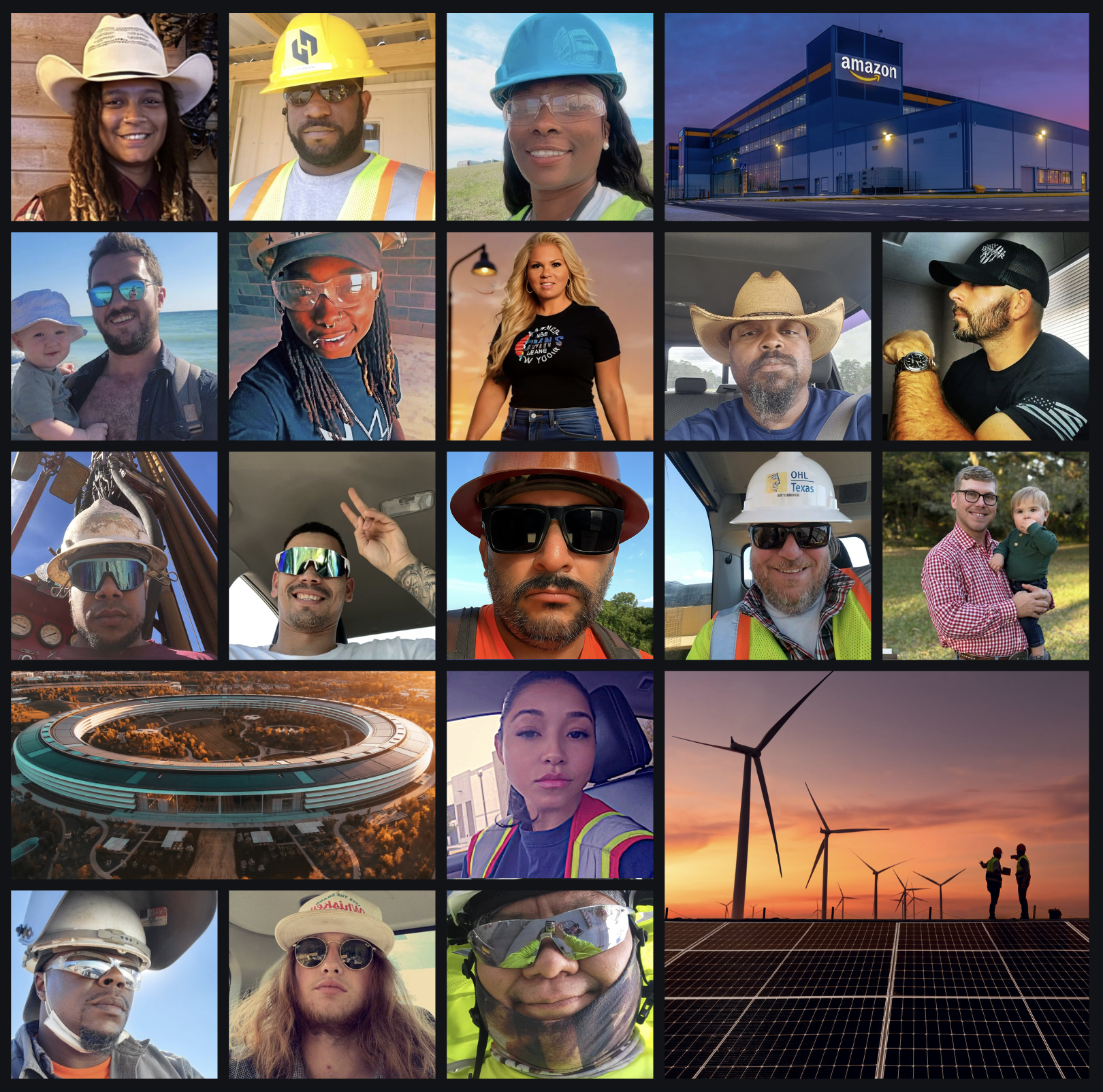
Veterans transitioning into civilian careers, more women entering the trades, and workers building durable careers without four-year degrees across both rural and urban America. About 10% of workers show evidence of military service, nearly 10% are women, and roughly 75% of hires come from non-college pathways, reinforcing construction as a critical middle-class career ladder. While projects are concentrated in major infrastructure metros, over a quarter of workers originate from smaller and rural communities, expanding access to economic mobility nationwide.
Craft careers started
Active trade-region cells (e.g. carpenters in Dallas, TX) have grown 3x in the past quarter as Skillit’s AI increases recruiter productivity and hiring liquidity across markets. Some cells now show meaningful market share (as high as 40%), while newer ones are scaling rapidly (as fast as 88% m/m).
Likewise, hiring activity on Skillit is beginning to compound. Since launching Sam, our AI interview scheduler, in early 2025 and reaching liquidity in several priority markets, the platform is converting supply into interviews and hires more efficiently — creating a flywheel where more workers lead to more connections, more hires, and more predictable outcomes for contractors.
Those hires are seeing a 14% uplift in pay and benefits on average compared to their prior role. The biggest gains (between 20% and 30%) come when workers move from small shops with sub $10M in revenue to national contractors like DPR, Mortenson, and Swinerton who are building out America's data and energy infrastructure. Then we have mid-tier transitions delivering 10–20% improvements as workers gain access to stronger benefits and more predictable pay from our enterprise customer base.
Workers on Skillit are also entering durable construction careers across a wide range of trades. Placement volume today reflects both customer hiring demand and where Skillit has reached meaningful supply density.
Its not surprising given our Top ENR customer base that Skillit hiring is strongest in high-growth infrastructure corridors like Texas, Georgia, Arizona, Tennessee, and Florida where data center, energy, and industrial projects are growing quickly and creating durable craft employment.
Infrastructure unlocked
Enterprise adoption of Skillit is accelerating as coverage expands across priority trade-region cells. Top ENR customers with $1B+ in revenue hiring via Skillit grew from 5 to 16 in five months (+2.5x growth), including 4 new enterprise customers in January alone.
And as more enterprise contractors adopt Skillit, workforce placement supports a growing number of active infrastructure projects especially data centers, energy, and large commercial projects.
Directly helping to unlock and enable significant infrastructure value.