What Concrete Workers Make Across Major U.S. Markets (2026)
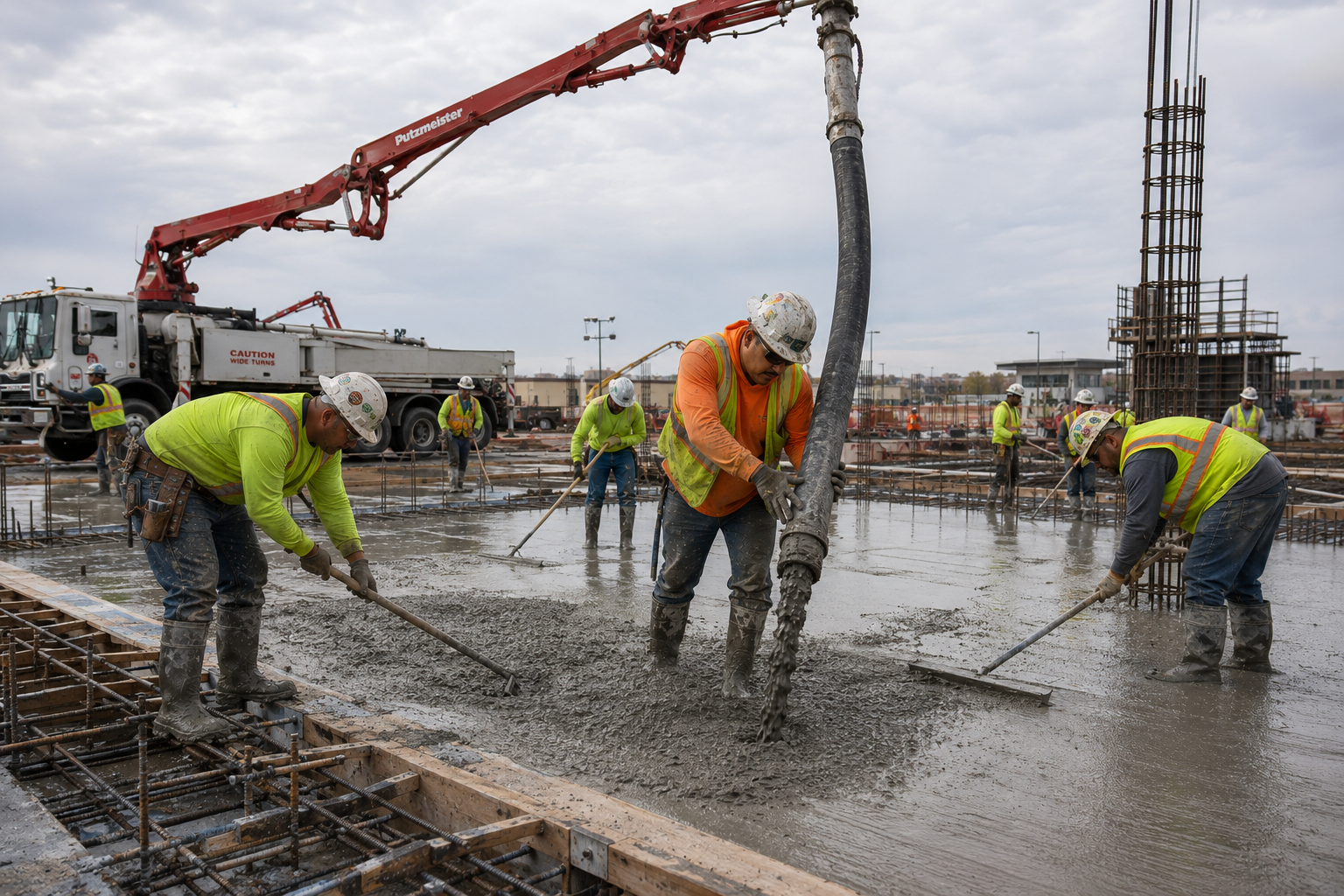
Quick Answer: Concrete workers in U.S. construction earn $18–$42/hr depending on market, role, and certification. Cement masons and concrete finishers earn more than general concrete laborers. ACI-certified finishers working on DOT and infrastructure projects can earn $28–$42/hr. Union scale in major markets (NYC, Chicago, LA) reaches $45–$60/hr including benefits.
How Concrete Worker Pay Is Structured
The concrete trades break into several distinct roles with different pay levels:
Concrete laborer: Forms stripping, concrete placement support, vibration, general site work. $17–$27/hr in most markets.
Concrete finisher / cement mason: Troweling, finishing, flatwork. More skilled, higher pay — $22–$38/hr in most non-union markets.
ACI-certified finisher: Required on many DOT, infrastructure, and publicly funded projects. Adds $2–$5/hr and unlocks prevailing wage work.
Foreman / lead finisher: $32–$48/hr on commercial and civil projects.
Fact: ACI Field Testing Technician — Grade I certification costs less than $200 and can be completed in one day. It opens access to DOT, airport, and infrastructure projects that pay prevailing wage, which is significantly above standard commercial rates.
Concrete Worker Pay by Market — 2026
Companion tables · What Concrete Workers Make Across Major U.S. Markets (2026)
Table 1 · Concrete Worker Pay by Market — 2026
Non-union and union package rates for concrete laborers, finishers, and cement masons across major U.S. markets.
| Market | Concrete Laborer | Finisher/Cement Mason (Non-Union) | Union Package Rate | Notes |
|---|---|---|---|---|
| Houston, TX | $17–$23/hr | $22–$34/hr | $36–$48/hr | TxDOT and City of Houston infrastructure drive prevailing wage work. Strong commercial flatwork market. |
| Dallas-Fort Worth, TX | $16–$22/hr | $21–$32/hr | $32–$44/hr | Highest concrete volume market in Texas. Data center slabs and commercial flatwork sustain demand. |
| Chicago, IL | $26–$36/hr | $28–$40/hr | $48–$62/hr | Heavily unionized. OPCMIA Local 502 and LIUNA strong on public projects. Non-union still benefits from wage pressure. |
| New York City, NY | $28–$40/hr | N/A (mostly union) | $55–$70/hr | Near-total union coverage on major projects. NYC Comptroller prevailing wage rates. |
| Los Angeles, CA | $24–$35/hr | $26–$40/hr | $48–$64/hr | Broad prevailing wage coverage. State infrastructure spending sustains concrete demand. |
| Phoenix, AZ | $16–$22/hr | $20–$30/hr | $30–$42/hr | Primarily non-union. Semiconductor/manufacturing buildout has created large-scale slab requirements. |
| Denver, CO | $18–$26/hr | $22–$34/hr | $34–$46/hr | Mixed market. DOT and municipal infrastructure projects pay prevailing wage. |
| Atlanta, GA | $15–$20/hr | $19–$28/hr | $28–$38/hr | Lower-cost market. Data center expansion in suburban corridors increasing concrete volume and wages. |
Non-union rates reflect base wages only. Union package rates include wages plus benefit contributions. ACI-certified finishers on prevailing wage projects earn toward the high end of the non-union range or above.
Houston, TX
Concrete laborer: $17–$23/hr
Concrete finisher (non-union): $22–$34/hr
Union cement mason (OPCMIA Local 526): $36–$48/hr package
Houston's concrete market is driven by commercial construction, infrastructure (TxDOT projects), and industrial slab work. Prevailing wage rates on DOT projects run $10–$15/hr above market for finishers in the Houston metro.
Dallas-Fort Worth, TX
Concrete laborer: $16–$22/hr
Concrete finisher (non-union): $21–$32/hr
Union cement mason: $32–$44/hr package
DFW is one of the highest-volume concrete markets in the country, driven by the scale of commercial and infrastructure development across the metroplex. Data center slabs, highway construction, and commercial flatwork keep demand high.
Chicago, IL
Concrete laborer: $26–$36/hr
Concrete finisher (non-union): $28–$40/hr
Union cement mason (OPCMIA Local 502): $48–$62/hr package
Chicago's concrete market is heavily unionized. The Cement Masons and the Laborers (LIUNA) have strong density on commercial and public projects. Non-union workers compete at lower rates but still benefit from the upward wage pressure that union density creates.
Fact: Union cement masons in Chicago earn some of the highest concrete wages in the country, with journeyman rates exceeding $40/hr in wages alone before benefit contributions.
New York City, NY
Concrete laborer (non-union): $28–$40/hr
Union cement mason (OPCMIA Local 780): $55–$70/hr package
NYC concrete wages reflect the city's extremely high prevailing wage rates. Almost all major concrete work — high-rise cores, foundation pours, infrastructure — is union. The complexity of working in dense urban environments also commands higher rates.
Los Angeles, CA
Concrete laborer: $24–$35/hr
Concrete finisher (non-union): $26–$40/hr
Union cement mason (OPCMIA Local 600): $48–$64/hr package
California's prevailing wage rules cover an extensive range of public and publicly funded projects. State infrastructure spending (highways, transit, water systems) keeps concrete demand high and wages elevated.
Phoenix, AZ
Concrete laborer: $16–$22/hr
Concrete finisher (non-union): $20–$30/hr
Union cement mason: $30–$42/hr package
Phoenix is a hot (literally and figuratively) concrete market. The semiconductor and manufacturing buildout has created large-scale slab requirements. Summer heat creates scheduling challenges and premium pay for workers willing to work extreme conditions.
Atlanta, GA
Concrete laborer: $15–$20/hr
Concrete finisher (non-union): $19–$28/hr
Union cement mason: $28–$38/hr package
Atlanta is a lower-cost market with substantial commercial construction. Data center expansion in suburban markets (Coweta County, Douglas County) has driven up concrete work volume and wages in areas that previously lagged.
FAQ
How much do concrete finishers make per hour in 2026?
Concrete finishers earn $20–$42/hr depending on market and certification. ACI-certified finishers on DOT and infrastructure projects earn toward the upper end. Union cement masons in major metros can earn $40–$60/hr in wages alone.
What is the highest-paying concrete job in construction?
Concrete foreman on large commercial or civil projects — bridges, tunnels, high-rise foundations — is the highest-paying concrete role. Lead finishers and ACI-certified masons on prevailing wage infrastructure work also earn significantly above market.
Does ACI certification increase concrete worker pay?
Yes. ACI Field Testing Technician Grade I certification opens access to DOT, airport, and infrastructure projects that pay prevailing wage. This typically adds $5–$12/hr above standard commercial flatwork rates depending on the market and project type.
What's the difference between a cement mason and a concrete finisher?
In practice, the terms are used interchangeably. Cement mason is the union trade classification; concrete finisher is the more common non-union descriptor. Both describe workers who place, level, smooth, and finish concrete surfaces.
Do concrete workers get overtime pay?
In most states, concrete workers on commercial and civil projects receive 1.5x overtime after 40 hours per week. Some non-union contractors offer straight-time overtime, which is legal in most states outside California. Always ask about the OT structure before accepting an offer.
Is concrete work physically demanding?
Yes. Concrete finishing is one of the more physically demanding trades. It involves extended time on knees, working against cure time, and outdoor exposure in all conditions. However, it also has a relatively short learning curve for basic placement and a longer development curve for high-quality finishing.
Can concrete workers work year-round?
In warm-weather markets (TX, AZ, FL, GA), yes concrete work is largely year-round. In cold-weather markets (Chicago, Denver, NYC), cold weather concrete placement is possible but requires protection from freezing and may slow scheduling. Winter months typically see reduced volume in northern markets.
How do I become an ACI-certified concrete finisher?
ACI Field Testing Technician — Grade I requires passing a written exam and a performance test. Study materials are available through ACI; most candidates prepare with on-the-job experience and a one-day review course. Testing is administered at ACI-approved sites. Cost is typically $150–$250 including study materials.
Internal Links
Find Your Next Job on Skillit
Skillit connects craft construction workers directly with contractors who are hiring. Build your profile once and get matched to jobs that fit your trade, experience level, and target pay.