

How do AI-powered platforms improve skilled worker acquisition?
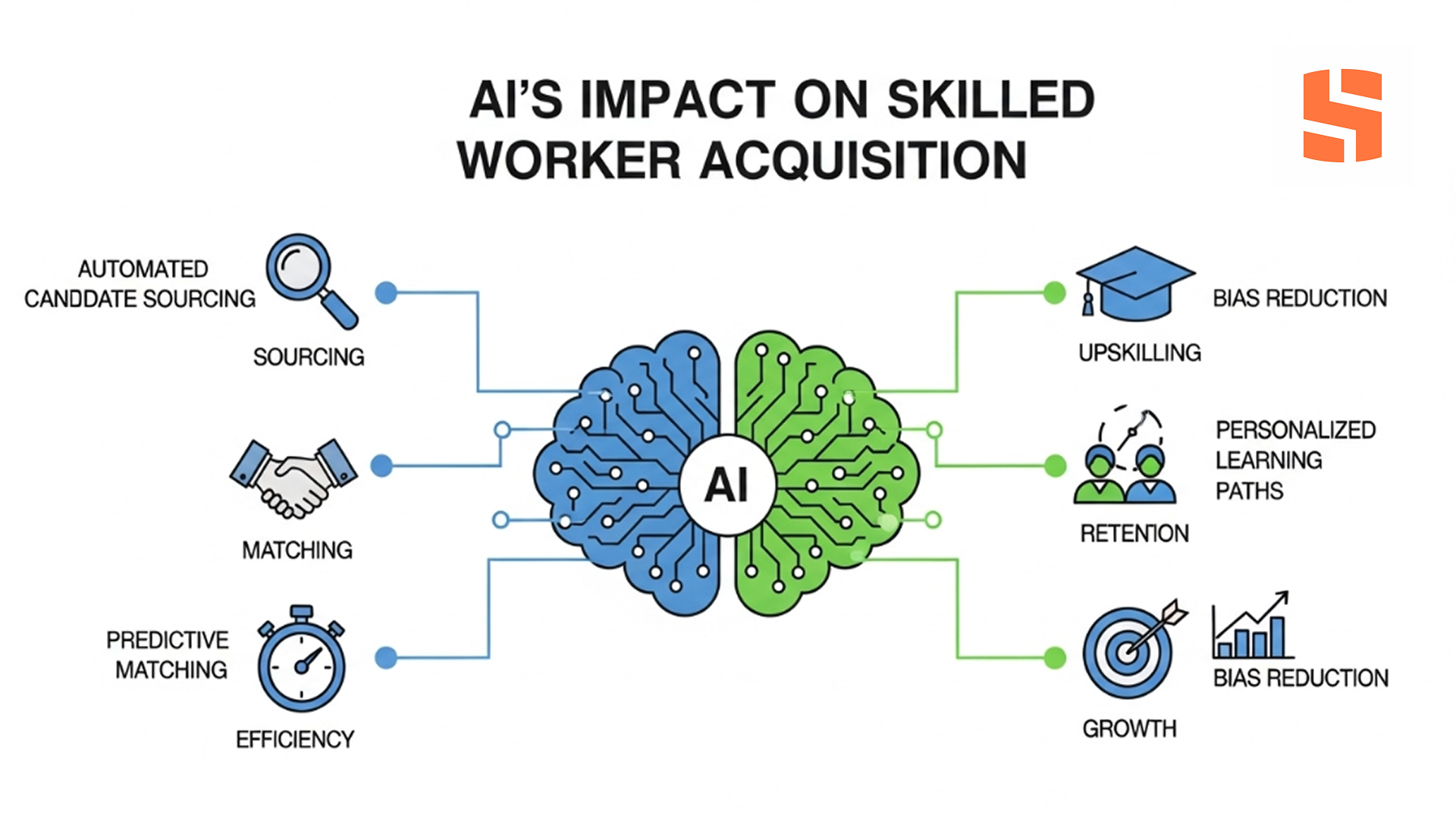
The construction industry has faced a long-standing challenge: finding and hiring skilled craft workers quickly enough to keep projects on schedule. Traditional hiring methods such as job boards, staffing agencies, and manual outreach often slow down the process and make it harder for companies to find the right talent.
AI-powered hiring platforms are changing this dynamic. By combining large worker databases, skills-based matching, and automation, these platforms help contractors identify qualified workers faster and with greater precision.
At Skillit, we built our platform to solve this problem. By using AI-powered technology, we help contractors identify, connect with, and hire skilled craft workers faster. Our platform combines intelligent skill matching, automation, and access to a growing network of vetted workers to simplify the hiring process.
This article explores how AI-powered platforms improve skilled worker acquisition and why they are becoming essential for modern construction teams.
The growing challenge of skilled labor in construction
Before exploring solutions, it’s important to understand why hiring skilled workers has become increasingly difficult in the construction industry.
Many contractors struggle not because workers do not exist, but because they are hard to locate and connect with using traditional hiring channels. In short, many of the workers are more or less invisible to the average recruiter. Generic job boards often produce unqualified applicants, while recruiters spend large amounts of time manually screening candidates and coordinating interviews.
AI-powered platforms aim to solve this disconnect by organizing labor data, matching workers to roles intelligently, and automating repetitive recruitment tasks.
Key hiring challenges in construction include:
Difficulty finding workers with specialized trade skills
Slow hiring timelines that delay projects
Limited visibility into worker experience and certifications
Manual outreach and scheduling tasks that consume recruiter time
Fragmented communication between recruiters and candidates
These issues create bottlenecks that increase costs and reduce project efficiency. AI-driven hiring platforms address these problems by redesigning the recruitment process around skills, data, and automation.
In short, AI is helping construction companies move from reactive hiring to proactive talent acquisition.
AI-Driven talent matching for precision hiring
One of the biggest advantages of AI-powered hiring platforms is their ability to match workers with roles based on specific skills and experience.
Traditional hiring often relies on job titles or resumes that may not accurately reflect a worker’s capabilities. AI platforms instead analyze structured worker data such as certifications, trade specialization, experience levels, and location.
For example, Skillit uses detailed worker profiles and search filters that allow recruiters to identify candidates based on precise attributes like skills, commute distance, pay expectations, and previous employers.
This approach allows hiring teams to focus on candidates who are truly qualified for the job.
Benefits of AI-driven matching include:
Faster identification of qualified candidates
Better alignment between job requirements and worker skills
Reduced time spent screening unqualified applicants
Improved hiring accuracy for specialized trades
Greater visibility into worker qualifications and certifications
Instead of reviewing hundreds of resumes manually, recruiters can quickly narrow down the best candidates through intelligent search and filtering. This precision significantly improves the efficiency of skilled worker acquisition.
Access to large networks of vetted craft workers
Another major advantage of AI hiring platforms is access to large databases of pre-qualified workers.
Traditional job boards require employers to post a role and wait for applicants. In contrast, AI platforms allow companies to actively search through networks of workers who already have verified profiles and skills.
Skillit provides access to a growing network of vetted craft workers across dozens of trades and locations. Recruiters can search this database instantly and view detailed worker profiles before initiating contact.
This dramatically expands the talent pool available to construction companies.
Key benefits of large skilled worker networks include:
Immediate access to thousands of trade professionals
Reduced reliance on staffing agencies
Greater diversity of skills and experience levels
Faster sourcing of workers for urgent projects
Increased visibility into the broader labor market
By centralizing worker data in one platform, AI systems make it easier for contractors to find the right workers without relying solely on inbound applications. This shift from passive hiring to active talent search is a major improvement in workforce acquisition.
Automation of recruiting tasks
Recruiters often spend a significant amount of time on administrative tasks such as scheduling interviews, sending follow-up messages, and coordinating candidate communication.
AI platforms automate many of these repetitive processes, allowing recruiters to focus on evaluating candidates and making hiring decisions.
Skillit’s AI assistant, Sam, is designed specifically for construction hiring. The assistant can automate outreach, schedule interviews, send reminders, and manage follow-ups with candidates.
This automation improves efficiency and reduces delays during the hiring process.
Examples of automated recruiting tasks include:
Candidate outreach through email or messaging
Interview scheduling and calendar coordination
Automated reminders and follow-ups
Rescheduling interviews when needed
Managing communication with multiple candidates simultaneously
By removing these administrative burdens, recruiters can spend more time building relationships with candidates and assessing their qualifications. Automation also ensures faster responses, which is critical in competitive labor markets.
Faster hiring and reduced project delays
Construction projects often operate under strict timelines. Delays in hiring skilled workers can lead to costly schedule disruptions.
AI hiring platforms help companies reduce time-to-hire by streamlining sourcing, screening, and scheduling.
Instead of waiting weeks for applicants, recruiters can identify and connect with qualified candidates almost immediately. Some platforms also provide labor market insights and search tools that help employers quickly locate workers in specific geographic areas.
This faster hiring process offers several advantages:
Reduced project delays caused by labor shortages
Faster workforce scaling for new projects
Improved recruiter productivity
Higher candidate response rates
Shorter hiring cycles
AI platforms can reduce administrative work by dozens of hours per hire, helping contractors focus on project delivery rather than recruitment logistics. Ultimately, faster hiring translates directly into improved project efficiency and profitability.
Better collaboration for hiring teams
Hiring skilled construction workers often involves multiple stakeholders, including recruiters, hiring managers, and project leaders.
AI platforms centralize candidate data and communication, making it easier for teams to collaborate during the hiring process.
Modern hiring platforms provide features such as shared candidate profiles, feedback tracking, and team-wide access to recruitment workflows. These tools help teams stay aligned and make faster decisions.
Key collaboration benefits include:
Shared access to candidate profiles and notes
Improved transparency in hiring decisions
Easier coordination between recruiters and project managers
Faster evaluation of candidate fit
Streamlined communication across teams
With everyone working from the same data and platform, hiring teams can make decisions more efficiently and avoid miscommunication. This collaborative approach strengthens the overall hiring process.
Conclusion
AI-powered hiring platforms are transforming how construction companies approach recruitment. Instead of relying on fragmented tools and manual processes, contractors can now use centralized platforms that combine worker data, automation, and intelligent matching.
Skillit illustrates how technology can solve some of the construction industry’s biggest workforce challenges. By organizing worker information, expanding access to skilled labor networks, and automating repetitive tasks, AI systems make it easier for companies to build strong craft teams.
Looking ahead, AI-driven hiring will likely become the standard approach for workforce acquisition in construction and other skilled industries.
For companies that need to hire quickly and efficiently, adopting AI-powered hiring infrastructure is no longer just an advantage. It is becoming a necessity.
