


Top 10 interview questions for skilled trade workers
Hiring in the construction industry is different from hiring in an office. Skilled trade workers are evaluated on real experience, technical knowledge, safety awareness, and reliability. That’s why construction job interview questions tend to focus less on theory and more on practical problem-solving, jobsite behavior, and hands-on skills.
Whether you’re a plumber, welder, carpenter, electrician, or general laborer, knowing how trade worker interviews are conducted can significantly improve your chances of getting hired.
This guide breaks down the top 10 interview questions for skilled trade workers, explains why employers ask them, and shows how to answer construction interview questions with confidence.
Why construction interviews are different from other job interviews
Before jumping into the questions, it’s important to understand why construction interview questions are structured the way they are.
In skilled trades, employers are hiring for:
Jobsite safety and compliance
Proven technical ability
Reliability and attendance
Ability to work under pressure
Team communication on active sites
Unlike white-collar roles, most construction hiring managers have limited time. They want fast, honest answers backed by experience. This is why construction interview tips matter for hiring is not just a theory question. Poor hiring decisions in construction lead to jobsite delays, safety incidents, and costly rework.
According to industry data from OSHA and the Bureau of Labor Statistics, construction consistently ranks among the highest-risk industries for workplace injuries. That makes safety knowledge and experience a top priority during interviews.
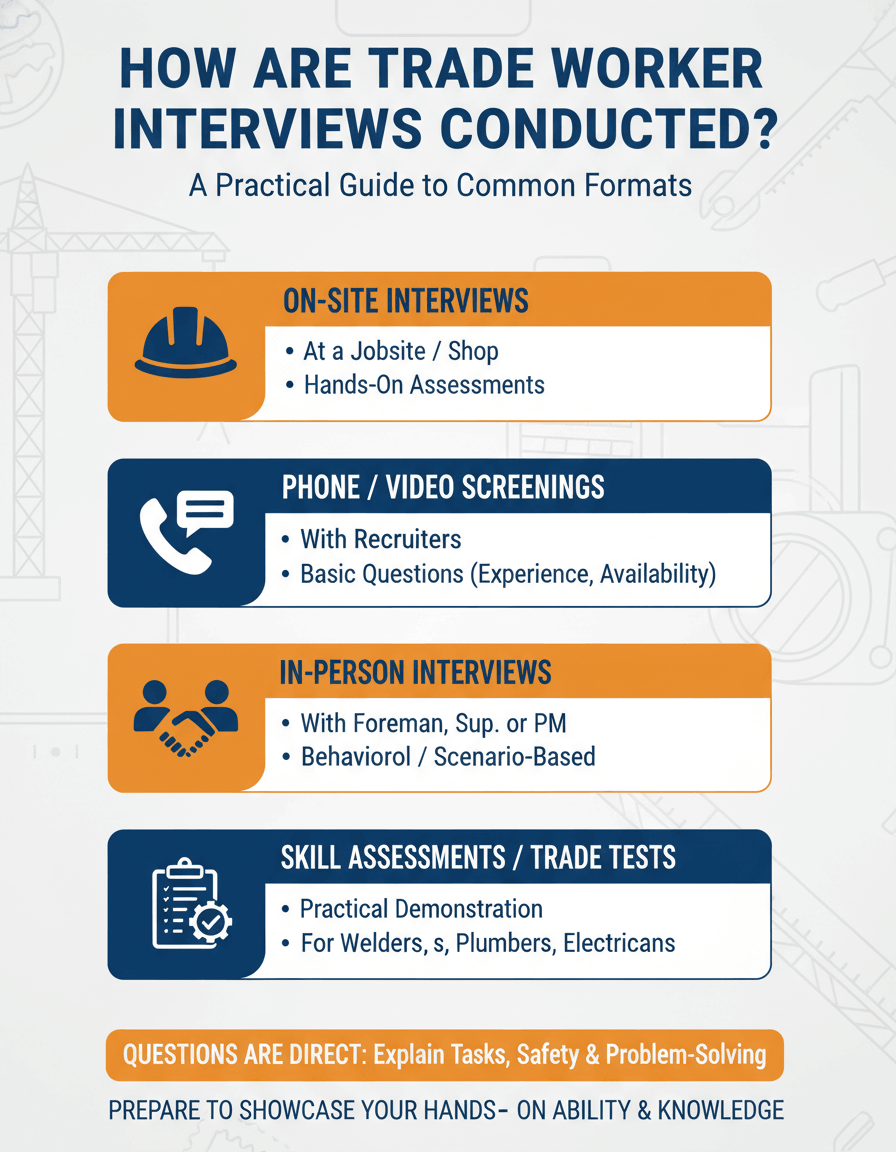
How trade worker interviews are conducted?
Understanding how trade worker interviews are conducted helps you prepare correctly.
Most construction job interviews follow one of these formats:
On-site interviews at a jobsite or shop
Phone or video screenings with recruiters
In-person interviews with a foreman, superintendent, or project manager
Skill assessments or trade tests (especially for welders, plumbers, and electricians)
The questions are often direct. You may be asked to explain how you performed a task,
handled a safety issue, or solved a real jobsite problem. Some employers may also ask
scenario-based technical trade interview questions.
Preparing for a construction job interview takes more than showing up with experience. Knowing what questions to expect can give you a real advantage. Below are the top 10 construction job interview questions skilled trade workers are most commonly asked, along with what hiring managers are really looking for in your answers.
Top 10 construction job interview questions for skilled trade workers
Interview question 1:
Can you tell me about your construction experience?
This is one of the most common construction job interview questions, and it usually sets the tone for the entire conversation. Employers are listening for specific details about your background, not general statements.
How to answer effectively:
Mention your trade and years of experience
Describe the type of work you’ve handled
Highlight the environments you’ve worked in
Example Answer:
“I’ve been working in commercial construction for six years. Most of my experience is in concrete and framing on large commercial projects like warehouses and retail centers. I’m comfortable reading blueprints, working with power tools, and following site safety protocols.”
A strong answer explains your experience clearly without exaggeration. Employers prefer honesty because overstated skills create risk once the job starts.
Interview question 2:
What types of construction projects have you worked on?
This question helps employers determine whether your background aligns with their current projects. Someone experienced only in residential work may struggle on large commercial or industrial sites, and vice versa.
What to include in your answer:
Residential, commercial, or industrial projects
Small-scale vs. large-scale jobs
Indoor, outdoor, or specialized environments
If your experience does not perfectly match the role, explaining how you adapt to new environments can still work in your favor.
Interview question 3:
How do you handle jobsite safety?
Safety questions appear in nearly every construction interview. The construction industry consistently ranks among the highest-risk industries for workplace injuries, which makes safety knowledge a top hiring priority.
When employers ask about safety, they want to know whether you follow rules, use protective equipment correctly, and speak up when something is unsafe. Answering this question well shows maturity and professionalism.
A strong response explains your approach to safety as part of your daily routine, not something you think about only when asked. This is a key part of learning how to answer construction interview questions effectively.
Example answer:
“I always wear required PPE and follow site-specific safety plans. I’ve completed OSHA 10 training and participate in daily toolbox talks. If I see an unsafe condition, I report it immediately.”
Interview question 4:
Can you read and understand blueprints or technical drawings?
This is a common question in technical trade interview questions, especially for skilled trades like carpentry, welding, and plumbing. Blueprint reading reduces errors and helps crews work efficiently.
Be honest about:
Your level of blueprint experience
How you use drawings to guide your work
When you ask questions to avoid mistakes
Example answer:
“I regularly read blueprints to understand dimensions, materials, and installation details. I double-check drawings before starting work to avoid mistakes.”
Even basic blueprint familiarity is valuable if you explain how you use drawings to guide your work and avoid mistakes.
Interview question 5:
How do you handle tight deadlines and pressure?
Construction schedules are often tight, and delays cost money. Employers ask this question to understand how you manage stress without cutting corners or compromising safety.
A good answer explains how you stay organized, communicate with your supervisor, and keep safety as a priority even when deadlines are tight. Avoid claiming that pressure never affects you. Employers prefer realistic answers that show awareness and responsibility.
Example answer:
“I prioritize tasks, communicate with my supervisor, and stay focused on safety even when deadlines are tight.”
Interview question 6:
What tools, equipment, or machinery are you comfortable using?
In construction, productivity and safety depend heavily on tool familiarity. That is why this question appears so often in construction job interview questions and technical trade interview questions. Employers want to know whether you can step onto a jobsite and contribute without extensive retraining.
When answering:
Mention tools you’ve actually used on the job
Focus on equipment relevant to the role
Emphasize safe and correct usage
Example Answer:
“I regularly use power tools like drills, grinders, and saws. I’m also certified to operate scissor lifts and forklifts, and I follow all equipment safety guidelines.”
Employers value workers who understand not only how to use tools, but also how to use them safely and correctly. Clear, specific answers build trust and reduce uncertainty for hiring managers.
Interview question 7:
How do you work with a construction crew?
Construction work rarely happens alone. Crews rely on communication, coordination, and mutual respect to stay productive and safe. This question helps employers understand how you fit into a team environment.
When answering this construction interview question, explain how you communicate with supervisors and coworkers, how you follow direction, and how you handle shared responsibilities.
Employers are listening for signs that you understand your role within a larger workflow. A worker who can cooperate with others and adjust when plans change is far more valuable than someone who only focuses on their own task.
Example answer:
“I communicate clearly with my crew and supervisor, especially when tasks overlap. If I finish my work early, I help where needed to keep the job moving.”
Interview question 8:
Have you ever made a mistake on the job? How did you handle it?
Mistakes happen in construction, especially in fast-paced or complex projects. Employers ask this question to assess honesty, accountability, and problem-solving ability. It is one of the most revealing common construction interview questions.
A strong response explains:
What went wrong
How you reported and fixed it
What you learned to prevent repeat issues
Employers respect workers who take responsibility and improve. This approach shows maturity and professionalism, which are essential in construction environments.
Example answer:
“Early in my career, I misread a measurement and had to redo part of the installation. I reported it immediately, corrected it, and now I double-check measurements before starting.”
Interview question 9:
How reliable are you with attendance and punctuality?
Reliability is one of the most important traits in construction. One late or absent worker can disrupt an entire schedule. That is why attendance-related questions appear frequently in construction interview questions.
When responding, emphasize that you understand how important showing up on time is for a crew. Employers want reassurance that you plan ahead, communicate issues early, and take responsibility for your schedule.
Example answer:
“I understand how important attendance is in construction. I show up on time, notify my supervisor if there’s an issue, and plan ahead to avoid missed days.”
Even highly skilled workers can lose opportunities if they are seen as unreliable, which makes this question critical in the hiring process.
Interview question 10:
Why should we hire you for this construction role?
This final question gives you the opportunity to summarize your value. Employers are not looking for exaggerated claims. They want a clear explanation of why you are a good fit for the role and the team.
When answering, connect your experience, safety mindset, and work ethic to the needs of the job. A confident but grounded response shows that you understand what the employer expects and that you are serious about the opportunity. This is often the moment when hiring managers decide whether to move forward.
Example answer:
“You should hire me because I bring hands-on experience, a strong safety focus, and a reliable work ethic. I take pride in my work and want to grow with the company.”
Trade worker interview tips that actually improve hiring chances
Many candidates fail interviews not because of skill, but because they don’t prepare correctly.
You should:
Bring certifications or licenses so employers can verify qualifications quickly.
Wear clean, work-appropriate clothing that reflects the job site environment.
Arrive early to demonstrate punctuality and respect for schedules.
Speak clearly and honestly about your experience and limits.
Not exaggerate skills, since gaps are often exposed on the job.
These construction interview tips are simple but effective. When followed consistently, they improve trust, reduce hiring risk, and increase your chances of getting an offer.
Trade-specific interview question examples
Plumber Interview Questions
Plumbers may be asked about:
Reading plumbing schematics
Water pressure testing
Code compliance
Diagnosing leaks or clogs
Example Question:
“How do you ensure plumbing installations meet local code requirements?”
Welder Interview Questions
Welders often face:
Weld test requirements
Questions about welding positions
Metal types and joint preparation
Example Question:
“What welding processes are you most experienced with, and in what positions?”
Carpenter Interview Questions
Carpenters may be asked about:
Framing methods
Finish work
Measuring and layout accuracy
Example Question:
“How do you ensure accuracy when framing walls or installing cabinets?”
Preparing for these technical trade interview questions improves your confidence and performance.
While many construction interview questions are universal, some trades face more specialized questions.
Understanding the interviewer’s mindset helps you tailor your responses. Most construction hiring managers evaluate candidates on five core factors:
Safety awareness
Technical competence
Reliability and attendance
Attitude and teamwork
Ability to learn and adapt
Your answers to construction interview questions should touch on at least one of these areas, even if indirectly.
For example, when answering tool-related or technical trade interview questions, mentioning safety procedures shows responsibility. When discussing teamwork, highlighting communication shows professionalism.
How hiring managers evaluate skilled trade workers in interviews
Not every skilled trade worker walks into an interview with years of jobsite experience. Entry-level workers, apprentices, and career switchers are common in construction hiring. Employers understand this, but they still expect honesty and preparation.
When experience is limited, learning how to answer construction interview questions means focusing on what you do know. Training, safety awareness, and a willingness to learn carry real weight.
Employers often prefer a motivated worker who follows rules over someone who claims experience they cannot back up. Clear communication about your current skill level builds trust and reduces risk for the employer.
How to answer construction interview questions with limited experience
Construction job interview preparation tips most workers overlook
By the third month, James’s training began to resemble actual job conditions. Projects became more complex, and expectations increased.
Many candidates prepare answers but ignore everything else. These overlooked details matter more than you think.
1. Bring Proof of Credentials
Licenses, certifications, and completed training immediately boost credibility. Bring physical copies and digital backups. Having OSHA cards, trade licenses, or apprenticeship records ready shows professionalism and saves time during verification.
2. Understand the Company’s Work
Know whether they focus on:
Residential construction
Commercial projects
Industrial or infrastructure work
This helps you tailor examples, tools experience, and safety knowledge to their actual job sites.
3. Be Honest About Skill Levels
Overstating skills leads to failed tests or early termination. Hiring managers value honesty because it prevents accidents, delays, and rework. Clear communication helps place you correctly.
How to prepare for construction job interviews the right way
To summarize how to prepare for construction job interviews:
Review job descriptions:
Read the posting carefully and note required skills, tools, certifications, and experience. Be ready to explain how your background matches what they’re asking for, not just generally but job by job.
Practice answering common questions:
Expect questions about safety, teamwork, reliability, and problem-solving. Practice clear, direct answers so you don’t ramble or freeze during the interview.
Refresh trade-specific knowledge:
Review basics of your trade, current codes, equipment, and safety standards. Employers want confidence, accuracy, and up-to-date knowledge.
Prepare real examples:
Bring specific stories from past jobs that show your skills, work ethic, and ability to handle challenges on site.
Understand employer expectations:
Know their projects, work schedule, and standards so you can show you’re a good fit.
This preparation separates serious professionals from unprepared applicants.
Conclusion
Construction interviews are not about impressing someone with words. They are about showing that you are capable, dependable, and safe to put on a jobsite.
By understanding construction interview questions, practicing how to answer construction interview questions, and following proven construction interview tips, skilled trade workers can significantly improve their chances of being hired.
This trade worker interview guide was built to reflect how construction hiring actually works. Preparation, honesty, and clarity matter more than anything else. When you approach interviews with that mindset, you position yourself as a worker employers can trust.
FAQ:
What are the most common construction job interview questions?
Common construction interview questions focus on experience, safety habits, reliability, and teamwork. Employers want to know if you can work safely, follow instructions, and perform consistently on a jobsite.
How should I prepare for a construction job interview?
Review your work experience, refresh safety knowledge, and understand the employer’s type of projects. Clear, honest answers show professionalism and reduce hiring risk.
How are trade worker interviews usually conducted?
Most trade worker interviews are practical and informal. They may happen on a jobsite, in a shop, over the phone, or include skill tests for certain trades.
What kind of technical trade interview questions should I expect?
Questions depend on your trade. Plumbers are asked about installations and codes, welders about processes and materials, and carpenters about measurements and accuracy.
Why do construction employers care so much about reliability?
Reliable workers keep projects on schedule. Late arrivals or missed days disrupt crews and increase costs, making attendance a key hiring factor.
Why do construction job interview preparation tips matter so much?
Preparation shows commitment and professionalism. Prepared workers adapt faster, work safer, and earn employer trust more quickly.
Skillit connects craft workers with construction companies for great job opportunities
Build a complete profile and be found by top construction companies today.