

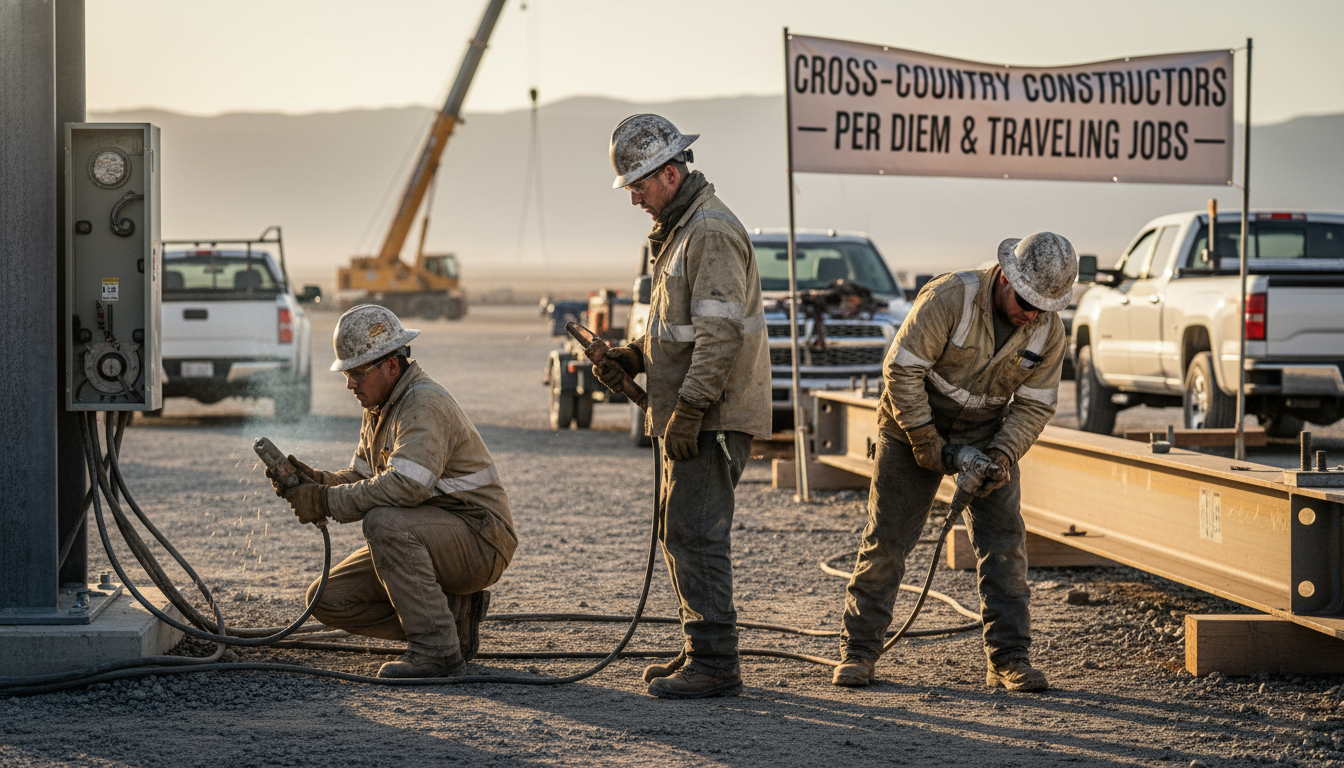
Per diem & traveling construction jobs
Traveling construction jobs have always been part of the industry, but the demand for mobile skilled tradesworkers has grown sharply in the last decade. Companies need people who can move from project to project, fill labor shortages, and bring specialized skills to locations where the talent pool is thin. For many workers, this creates a clear opportunity: steady work, higher hourly rates, and the chance to earn per diem on top of regular pay.
If you are looking for construction jobs with per diem pay or trying to understand how per diem works in construction, this guide breaks down everything you need to know. We will cover the best cities for per diem construction jobs, the most in-demand trades, how traveling construction jobs operate, how companies calculate per diem, and what kind of benefits you can expect in today’s travel trades jobs with benefits.
Whether you are a carpenter, welder, electrician, or a general traveling construction worker, this article will help you decide if the travel lifestyle is right for you.
What is per diem in construction jobs?
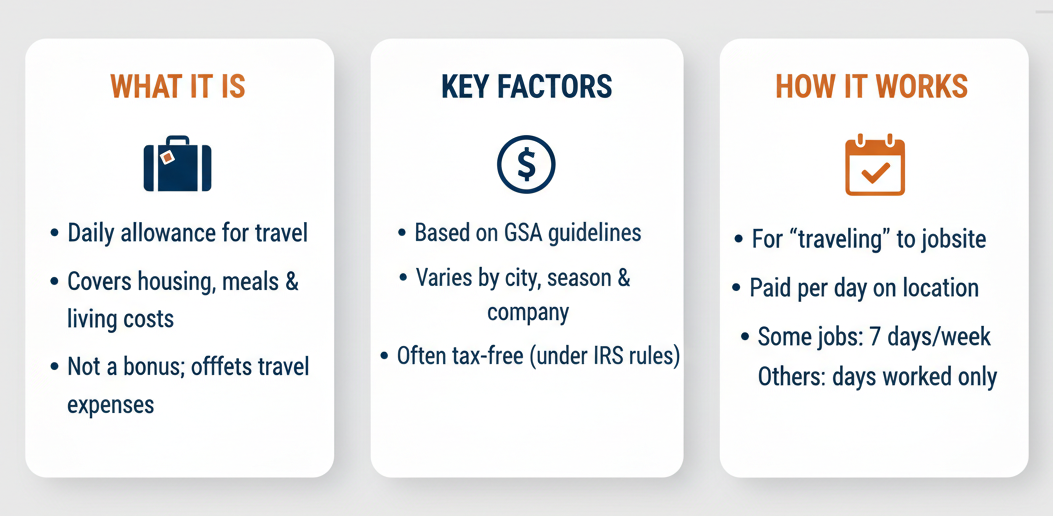
Per diem is a daily allowance paid to workers who travel away from home for a job. In construction, this usually covers housing, meals, and basic living costs. It is not the same as a bonus. It is meant to offset the fact that you are staying on the road and paying for expenses you normally wouldn’t have at home.
Most companies follow federal GSA guidelines to set their rates. The exact number depends on the city, the season, and the company’s budget. In many cases, per diem is tax free when the worker meets IRS rules, which is one reason these construction jobs that pay per diem are so popular.
Workers often ask how per diem works in construction. The short version is simple. If you live far enough from the jobsite to qualify as “traveling,” and the company needs you on location, you get a set amount every day you show up to work. Some jobs pay per diem seven days a week. Others only pay on days worked.
Why traveling construction jobs are growing across the USA
There are three main reasons traveling construction jobs keep expanding
1. Skilled labor shortages
Contractors in many regions cannot fill demand with local workers. Traveling skilled trades jobs fill that gap fast. Electricians, welders, millwrights, and carpenters are especially in demand.
2. Large industrial and energy projects
Power plants, data centers, refineries, and pipeline projects often need hundreds or even thousands of workers for short periods. This drives demand for per diem pipeline construction jobs, per diem electrician jobs, per diem welder jobs, and traveling carpenter jobs.
Many of these projects are located in remote or rural areas where there is limited local labor and specialized skills, making temporary and traveling workers essential to getting the job done.
3. Tight project deadlines
Big builds run on strict schedules. Companies bring in extra labor from across the country to keep timelines on track.
Because of this, many workers now treat traveling construction jobs as a long-term career path, not a temporary option.
How do traveling construction jobs work?
People often ask how traveling construction jobs work or how traveling construction jobs operate day to day. This basic setup is consistent across most companies.
1. You apply or get discovered by a contractor
Many traveling jobs are filled through networks or platforms like Skillit, where employers can find workers with specific certifications and relocation availability.
2. You receive the full pay package upfront
A typical breakdown includes:
Base hourly wage
Per diem rate
Overtime expectations
Schedule (often 6–7 days per week)
Travel or mobilization reimbursement (sometimes)
3. You travel to the job site
Some companies book your flight or reimburse mileage. Others provide a stipend.
4. You secure lodging
Depending on the contractor, they may:
Pay you per diem and let you pick your own hotel
Provide a hotel directly
Offer RV park reimbursement
Offer a man-camp or workforce lodging facility
This varies by job type and location.
5. You work the project until completion
Most traveling workers stay until:
A phase is finished
Their trade is no longer needed
The full project wraps
Short-term assignments often pay the highest per diem.
6. You either take a break or accept another travel job
Workers often move from one traveling project to the next, earning strong money year-round.
For many workers, the combination of long hours and per diem makes these construction travel jobs USA-wide some of the highest-earning roles in the trades.
To earn well in the travel trades, you must understand how per diem works in construction. Per diem is not the same everywhere. Rates change based on project type, city, cost of living, and hiring urgency.
Most traveling workers use per diem for three things:
Understanding per diem construction pay
| Category | What It Covers | Notes |
|---|---|---|
| Lodging | Hotels, motels, rentals, RV spots | Often the biggest expense |
| Meals | Food, snacks, drinks | Fully tax-free |
| Incidentals | Laundry, parking, small travel needs | Included in IRS guidelines |
Per diem is meant to cover what your normal life at home would not. Because it's tax-free, per diem increases your take-home pay without raising your tax bracket.
Per diem rates in 2025
These numbers vary by city, but the national averages for construction are:
| City Type | Typical Per Diem Range |
|---|---|
| High-cost cities (NYC, Seattle, LA, San Francisco) | $175 – $250 per day |
| Mid-cost cities (Denver, Miami, Chicago, Austin) | $125 – $175 per day |
| Low-cost regions (Texas rural, Midwest, South) | $90 – $140 per day |
Industries like energy, pipelines, and shutdowns pay more because projects need workers fast.
Best cities for per diem construction jobs
This question comes up often because GSA rates vary widely, and some cities offer far better pay and more openings than others.
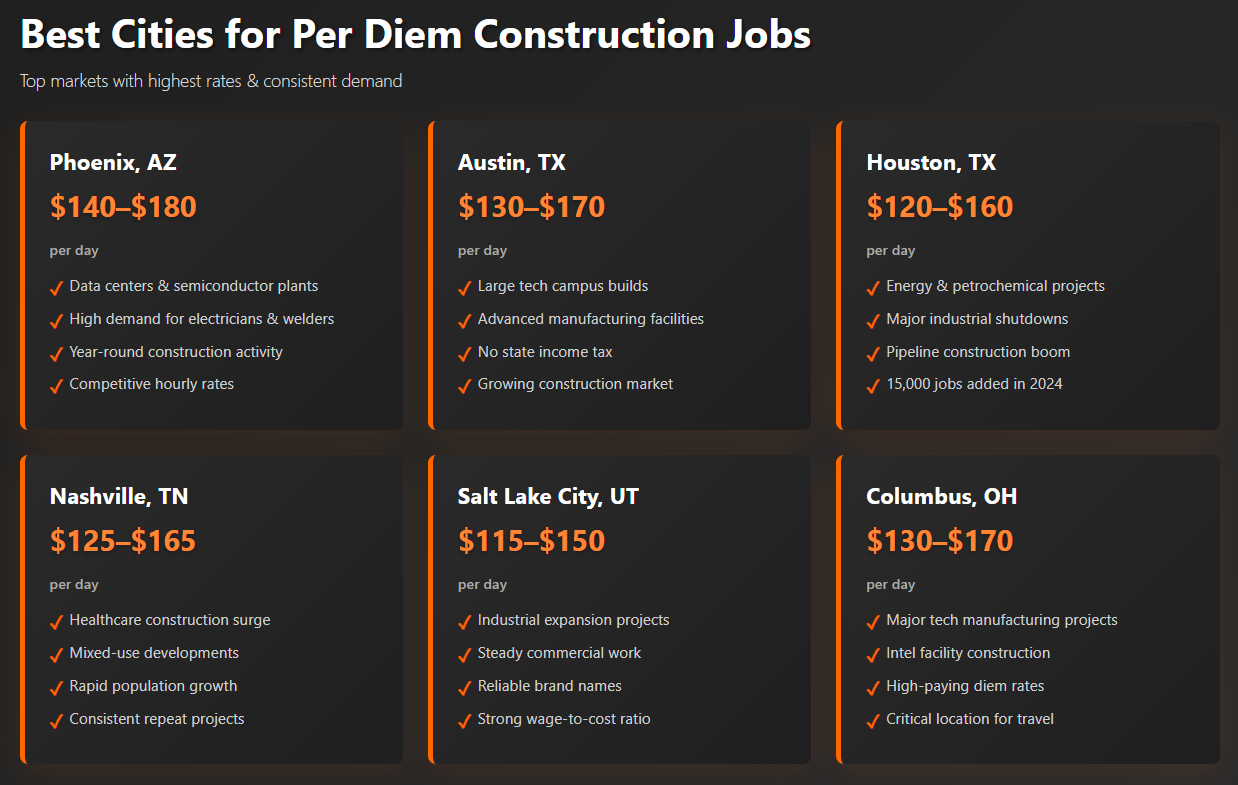
While opportunities shift with market cycles, several regions have consistently ranked among the best cities for per diem construction jobs. These include:
Phoenix, Arizona: Data centers and semiconductor plants have created a huge need for electricians, carpenters, and welders.
Austin, Texas:Large tech campuses and advanced manufacturing facilities attract traveling workers from across the country.
Nashville, Tennessee:Rapid growth in healthcare construction and mixed-use developments keeps demand high.
Salt Lake City, Utah:Industrial expansion plus steady commercial work make SLC a reliable travel market.
Columbus, Ohio:Major tech manufacturing projects have put central Ohio on the map for high-paying per diem work.
These locations tend to offer strong pay packages, long schedules, and consistent repeat projects.
How companies calculate per diem
Per diem rates in construction aren’t random. Most companies follow one of three approaches:
1. GSA federal per diem rates
The U.S. General Services Administration updates maximum reimbursable rates each year for every county in the country. These numbers set the upper limit for “reasonable” expenses, which helps companies stay compliant with IRS rules.
Contractors usually choose a daily rate somewhere under the GSA maximum. This keeps per diem tax free for the worker as long as other IRS rules are met.
2. Flat daily or weekly per diem
Some contractors simplify things by offering a flat amount each day you show up to work. For instance:
$100 per day on an industrial shutdown
$140 per day on a refinery project
$700–$1,000 weekly on long-term travel builds
Flat-rate setups are easy to track and popular with workers because they know exactly what to expect.
3. Company-provided housing plus meal stipend
Some employers book and pay for housing directly. This is common on remote energy projects or pipeline jobs where hotels are scarce. When the company handles housing, the worker may receive a smaller per diem just for meals and “incidentals.”
Regardless of the structure, understanding per diem construction pay is key to deciding whether a job is truly worth traveling for. Hourly rate matters, but per diem often doubles take-home income over a full travel season.
Per diem IRS rules that matter
Per diem pay is tax free only when the worker meets certain conditions. Most companies understand these rules well, but workers should too:
1. You must maintain a tax home.
A tax home is your regular place of residence. If you don’t have one, the IRS may treat you as an itinerant worker, which means per diem becomes taxable.
2. You must travel far enough away to require rest.
Driving across town does not qualify. You must be far enough away from home that staying overnight makes sense.
3. You must be working temporarily.
If a project lasts much longer than a year, the assignment may no longer qualify as temporary. When that happens, per diem can become taxable.
Most traveling construction workers never run into issues because project lengths and locations change often. Still, it helps to understand the basics to protect your income.
Per diem benefits for construction workers
Workers choose per diem jobs because the benefits are real:
Higher income
Lower taxes
Paid travel
Paid lodging
More consistent work
Stronger overtime opportunities
Experience on large, high-skill projects
Many workers who take travel trades jobs with benefits report earning more in 6 months than they once earned in a full year.
If you plan to travel for years instead of months, benefits matter. They turn a high-earning but temporary job into a sustainable career.
Pros and cons of traveling construction work
Travel work is not a fit for everyone. Here’s a realistic look at the lifestyle.
Pros
High earning potential: Between overtime and per diem, many traveling construction workers take home more than local workers in the same trade.
See new places: Whether you prefer big cities like Nashville and Phoenix or rural energy towns in Texas and North Dakota, travel work gives you variety.
Steady demand: Skilled trades shortages create reliable openings across the country.
Chance to build specialized experience: Working on data centers, refineries, or pipeline projects opens the door to higher-level jobs later.
Cons
Time away from home: For workers with families, long assignments can be hard unless schedules allow regular time off.
Long hours: Ten- and twelve-hour days for weeks at a time can wear on you.
Uncertain end dates: Projects sometimes run long or shut down early. Flexibility is part of the job.
Constant adjustment: New crews, new supervisors, and new routines take energy to manage.
Despite the challenges, many workers prefer traveling construction jobs because the pay and opportunities outweigh the trade-offs.
Industries with the most traveling construction jobs
While construction travel jobs USA-wide exist in every sector, a few industries dominate the listings:
1. Energy and Petrochemical
Refineries, natural gas plants, ethanol plants, and petrochemical facilities hire traveling welders, electricians, millwrights, pipefitters, and laborers during shutdowns and expansions.
2. Data Centers and High-Tech Manufacturing
Google, Meta, Intel, and other tech giants are building huge facilities across the country. These projects attract electricians, carpenters, concrete crews, and equipment operators—often with some of the highest per diem rates.
3. Commercial Construction
Hotel builds, hospitals, stadiums, and mixed-use buildings create steady demand for traveling carpenters, framers, drywall crews, and finishers.
4. Renewable Energy
Solar farms and wind turbine projects rely heavily on travel crews because they are often built in remote locations.
5. Infrastructure
Highway expansions, bridge work, water treatment plants, and public transit projects all need experienced workers willing to take temporary assignments.
What traveling workers actually earn
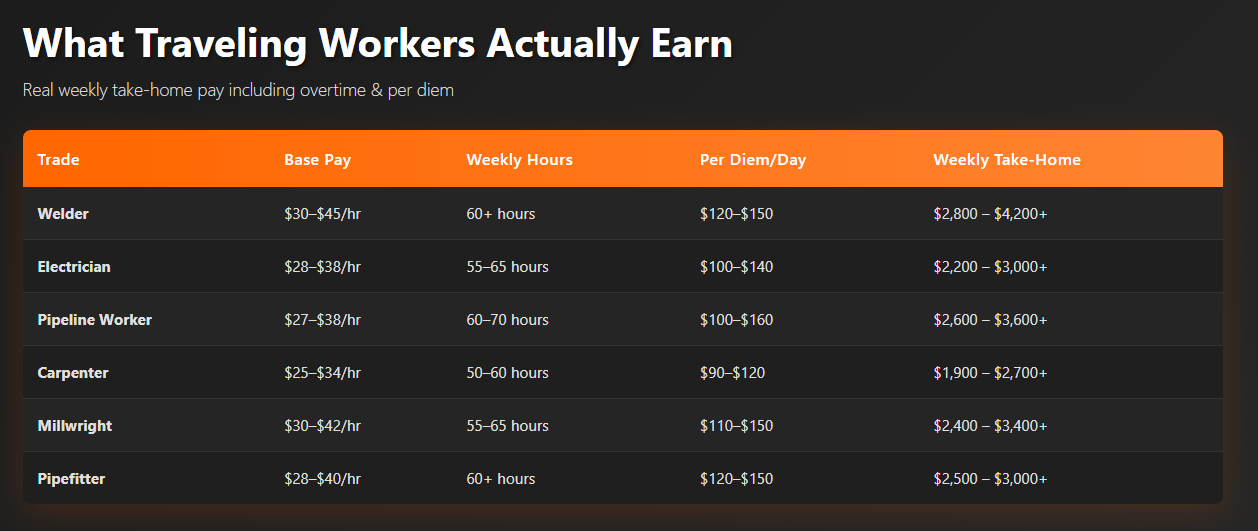
Pay varies by trade, project type, and location, but here are realistic examples based on current industry patterns. These are not inflated numbers. They reflect what many traveling workers report across the country.
Electrician
Base pay: $28–$38/hr
Overtime: Commonly 55–65 hours/week
Per diem: $100–$140/day depending on city
Total weekly take-home: $2,200–$3,000+
Large data center projects in states like Ohio, Arizona, and Utah keep these rates steady.
Carpenter
Base pay: $25–$34/hr
OT: 50–60 hours/week
Per diem: $90–$120/day
Total weekly take-home: $1,900–$2,700+
Traveling carpenter jobs are more stable across the year because commercial construction rarely shuts down completely.
Welder
Base pay: $30–$45/hr
Overtime: Often 60+ hours
Per diem: $120–$150/day
Total weekly take-home: $2,800–$4,200+ depending on certifications
Per diem welder jobs usually require passing a weld test on site. Projects involving shutdowns or pipeline tie-ins pay at the higher end.
Pipeline construction worker
Base pay: $27–$38/hr
OT: 60–70 hours/week
Per diem: $100–$160/day, sometimes more for RV housing
Total weekly take-home: $2,600–$3,600+
Per diem pipeline construction jobs often work in remote areas, which explains the higher daily rate.
How to find traveling construction jobs fast?
Now that you know where the best jobs are and which trades earn the most, here’s the part every worker cares about. This section gives you a clean step-by-step roadmap to land high-paying travel jobs efficiently.
Step 1: Build a Strong Digital Profile (Your New Hiring “Resume”)
Contractors hire fast when they can see:
Skills
Experience
Certifications
Tools you own
Past project types
Travel availability
Workers who create solid profiles on Skillit get hired faster because companies can filter by:
Trade
Skill level
Travel radius
Per diem preference
Certifications
Project history
If you want to get hired fast, your digital profile is the foundation.
Step 2: Target the cest cities for per diem construction jobs
Top cities include:
Phoenix
Houston
Seattle
Las Vegas
Los Angeles
Atlanta
New York
Workers searching construction travel jobs USA get the best results when they stick to proven high-per-diem regions with year-round demand.
Step 3: Apply for jobs online (But Only the Right Ones)
You want boards that show:
Per diem clearly
Pay rates upfront
Travel expectations
Required certifications
OT hours
Jobsite location
Platforms built specifically for construction (like Skillit) offer better visibility and faster matching.
Step 4: Follow up quickly—this is where workers win
Travel jobs hire fast, but they also fill fast. To stand out:
Answer calls immediately
Reply to texts within minutes
Keep your travel bags ready
Ask about start dates and onboarding
Confirm certifications and PPE
The workers who answer fastest get hired first.
This simple habit is the difference between landing a job in 1 day or missing it entirely.
What companies look for in traveling workers
Travel work pays well, but companies expect reliability. Here are the traits contractors value most:
1. Strong attendance
On travel jobs, one absent worker can slow the entire crew. Showing up matters.
2. Ability to adapt quickly
Jobsites change fast. Workers who learn new routines or tools without slowing down become favorites.
3. Willingness to take direction
Foremen often have tight deadlines, and workers who follow instructions without friction are brought back first.
4. Safety awareness
Accidents on industrial or energy projects can shut down the whole job. Workers who take safety seriously stand out.
5. Professional attitude
Travel crews live and work together. Contractors choose workers who keep things steady on and off the job.
Common per diem mistakes to avoid
Travelers sometimes lose money because they don't know the rules. Here are the most common mistakes:
1. Accepting low per diem in high-cost cities
NYC, Seattle, LA, Boston, and San Francisco have high expenses. If per diem is under $160/day in these cities, the job might not be worth it.
2. Forgetting to ask whether lodging is included
Some jobs offer hotel rooms instead of per diem. If so, lodging is covered and you still get a smaller daily allowance.
3. Assuming per diem is paid on off days
Many companies pay for travel days, orientation days and weather days. But not all. Ask early.
4. Not clarifying weekly hours
A per diem job without overtime might not pay as well as a local job with steady OT.
5. Not asking about job length
Travelers should know whether a project lasts. A good per diem job lasts long enough to make travel worthwhile.
Conclusion
Traveling construction jobs offer some of the highest earning potential in the trades. Between overtime, competitive hourly wages, and tax-free per diem, workers can earn more in a few months than many jobs pay in a full year. The lifestyle requires flexibility, long hours, and time away from home, but for many workers, the rewards outweigh the challenges.
Jobs exist for every skill level—from entry-level laborers to seasoned electricians, carpenters, and welders. Whether you’re searching for construction jobs with per diem pay, traveling carpenter jobs, per diem welder jobs, or per diem electrician jobs, opportunities continue to grow across the United States.
Understanding how per diem works in construction, how traveling construction jobs operate, and how to compare job offers helps workers make smarter decisions. With strong demand in tech manufacturing, energy, infrastructure, and commercial construction, the outlook for traveling skilled trades jobs remains strong for the next decade or longer.
If you want a career that pays well, teaches new skills, and opens the door to opportunities across the country, traveling construction work is one of the best paths available today.
FAQ:
1. What is per diem in construction jobs?
Per diem is a daily tax-free allowance that covers a worker’s meals, housing, and daily expenses when they travel for work. Workers keep whatever they don’t spend. It is separate from hourly wages and often makes travel jobs more profitable than local ones.
2. Is per diem the same as contract?
No, per diem is not the same as a contract. Per diem is a daily allowance for expenses, while a contract defines the terms of your employment or work agreement.
3. How do traveling construction jobs work?
They send you to out-of-state or across state project sites where you earn hourly pay, overtime, and daily per diem. You work until the project ends, then move on to the next job or state.
4. How do traveling construction jobs pay and operate?
They pay more because you earn high hourly wages, overtime, and weekly per diem. Many workers log 60+ hours per week, which pushes weekly earnings above $2,800.
5. What are the best cities for per diem construction jobs in 2025?
Cities with the strongest demand include Houston, Phoenix, Las Vegas, Tampa, Orlando, Denver, Charlotte, Nashville, and Salt Lake City. These locations consistently hire traveling trades due to major industrial and infrastructure projects.
6. Do I need experience to get traveling construction jobs?
You don’t always need extensive experience, but basic skills, OSHA training, and reliability are essential. Strong references or a portfolio help you get hired faster
Skillit connects craft workers with construction companies for great job opportunities
Build a complete profile and be found by top construction companies today.