For decades, the dominant story about skilled trades in America has been a story of decline. Shop class disappeared from high schools. Career counselors pushed four-year degrees. Parents quietly steered kids away from work boots and toward laptops. The cultural script was simple: trades were what you did if college didn't work out.
That script is unraveling, and faster than the industry seems to realize.
A new national survey from Skillit of 1,000 U.S. adults found that 47% of Americans have at some point considered a career in the skilled trades. Most never told anyone, and then they did nothing, because nobody told them where to start.
That silent demand collides with a workforce crisis that's getting louder by the month. JLL projects roughly 2.1 million skilled trades positions could go unfilled by 2030, with potential economic losses reaching $1 trillion annually according to U.S. Department of Education estimates. The supply gap is staggering: last year, nearly 600,000 jobs were posted for major skilled trades positions while only about 150,000 new workers entered through apprenticeships. The interest is there, but what's missing is the on-ramp.
Key Findings
47% of Americans have considered a career in the skilled trades, but only 15.4% have taken active steps (researching programs, contacting unions, enrolling in courses).
33.7% cite job security (work that can't be outsourced or automated) as their #1 motivation, edging out pay (28.2%).
29.6% of Americans think the average tradesperson earns under $60K a year, with that figure rising to 65.1% among the lowest earners.
21.6% say their single biggest barrier is simply not knowing where to start. Among women, that climbs to 25.1%.
39.1% wouldn't know where to begin looking for a trustworthy apprenticeship. Only 11.7% know exactly where to look.
48% say student debt or college costs have factored into their consideration of trades.
73% believe the skilled trades suffer from a prestige problem that actively keeps talented people out.
53% say a paid training program where they earn from day one would be the single biggest motivator to take a first step.
The Hidden Demand Nobody's Counting
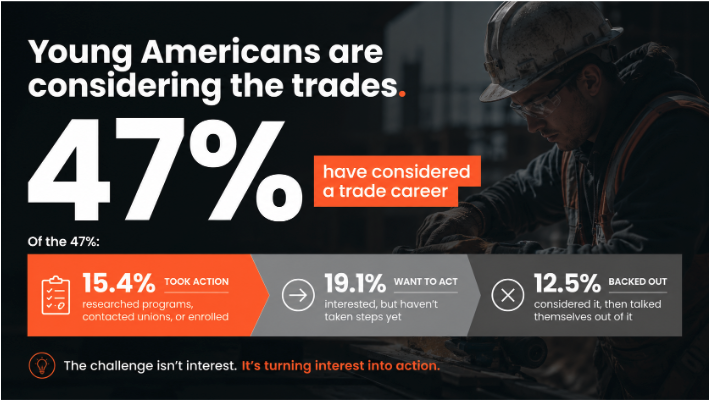
The conventional wisdom says that the trades have a recruitment problem because young Americans don't want the work. The data tells a different story. Of the 47% who've considered a trade career, 15.4% have already taken active steps, meaning they've researched programs, contacted unions, or enrolled in courses. Another 19.1% want to but haven't acted, and 12.5% thought about it before talking themselves out of it.
That last group is the most revealing. These are people who got close enough to the door to imagine themselves walking through, then turned around, usually without telling a soul. Their interest never showed up in any recruitment funnel because nobody knew it existed.
The picture shifts further when broken down by demographic. 24.8% of Black respondents and 24.7% of Hispanic respondents have already taken concrete steps toward a trade career, nearly double the rate of White respondents (13.3%).
The industry faces a multi-million-job deficit, not due to a lack of available talent, but because that talent remains undiscovered.
Job Security Beats Pay, and the Most Educated Are Listening Hardest
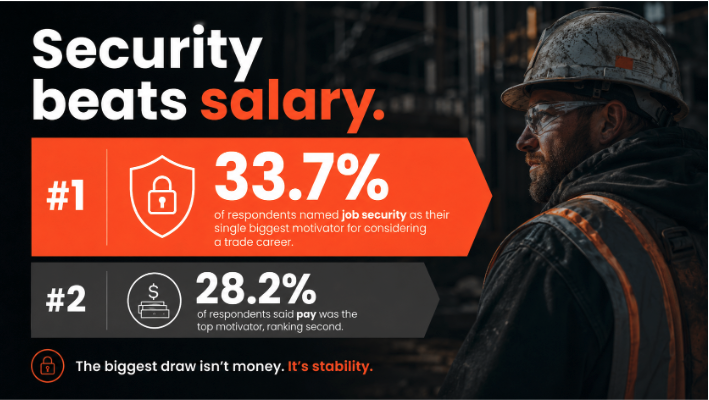
Ask someone why they're eyeing a trade career and most people assume the answer is money. The survey points somewhere else. 33.7% of respondents named job security, work that can't be outsourced or automated, as their single biggest motivator. Pay came in second at 28.2%.
The most striking part: that preference intensifies with income and education. Among Americans earning $100K–$249K, 39.7% put job security first. Among postgraduate professionals, it is 43.7%.
These are highly credentialed people doing the math on a specific set of changes:
Tech sector layoffs that have erased hundreds of thousands of white-collar jobs over the past two years;
AI tools that are rapidly absorbing analytical and creative work;
The quiet collapse of the assumption that a graduate degree equals stability.
A licensed electrician's work, by contrast, can't be automated, offshored, or restructured out of existence by a quarterly board decision. As JLL's research puts it, skilled trades offer the resilience of hands-on expertise that AI is positioned to augment but not replicate for any foreseeable horizon.
For a growing slice of the workforce, the trades have stopped looking like a step down and started looking like a strategic move.
Most Americans Have No Idea What Tradespeople Actually Earn
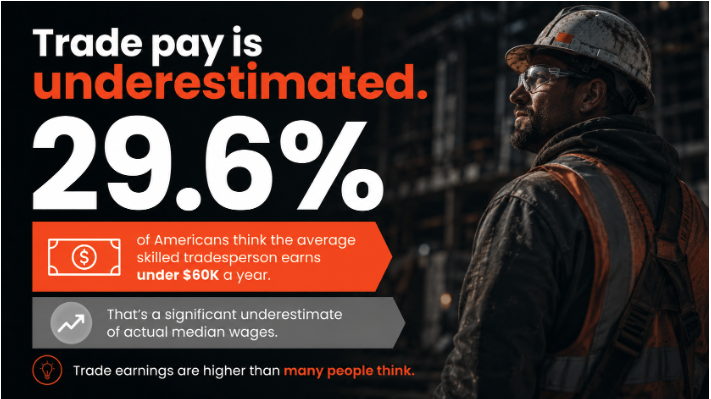
Pull on any thread of the skilled trades pipeline and you eventually hit a perception problem. 29.6% of Americans think the average skilled tradesperson earns under $60,000 a year, a significant underestimate of actual median wages once licensing and overtime are factored in.
Among Americans earning under $25K themselves, the demographic with arguably the most to gain from a career switch, 65.1% believe tradespeople earn under $60K. Only 10.7% of all respondents correctly estimate that experienced tradespeople earn $100K or more.
The cost of that misperception is measurable. When asked how they'd react to learning that a licensed electrician or plumber in their area earns $80K or more, 23.7% of Americans said they would seriously reconsider their current career immediately.
Among Hispanic respondents, that figure jumps to 39.7%. Among parents with kids under 18, it's 34.5%. Add the people who said the information would simply make them more curious, and over 60% of the country sits one accurate paycheck figure away from a real career conversation.
The #1 Barrier Isn't Money
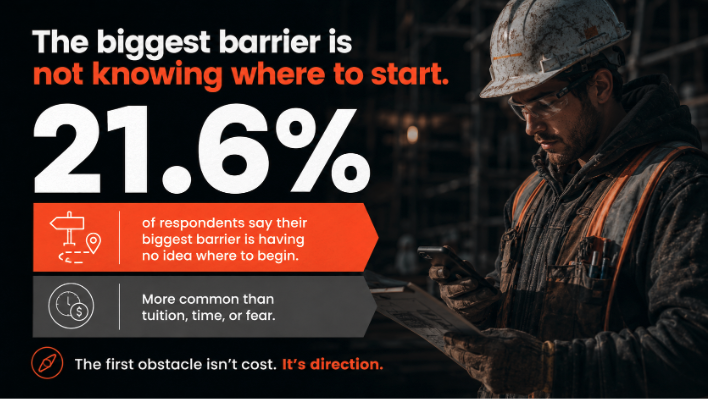
When asked what's stopping them, the single most common answer was navigation, not tuition, time, or fear. 21.6% of all respondents said their biggest barrier is having no idea where to even begin. Among women, it rises to 25.1%. Among Americans earning under $25K, it climbs to 27.9%.
Drill deeper and the picture gets worse. 39.1% of Americans say they wouldn't know where to look for a trustworthy apprenticeship or training program. Only 11.7% say they know exactly where to look. Among women, 45.9% have no confidence in their ability to find a program. Among Baby Boomers thinking about a second-act career, it's a striking 53.1%.
There's a second barrier that gets less attention but matters just as much: the body. 18.9% of all respondents cite long-term physical wear and tear as their biggest concern, and that figure jumps to 34.7% among Baby Boomers and 22% among women. Most trades industry messaging focuses on getting people in the door. This data suggests the harder conversation is about what happens 15 years later, when knees and backs start sending warning signals. Career changers won't commit to a path that has no clear answer to that question.
Together, these two barriers reframe the entire shortage. The trades are losing prospects to a Google search that goes nowhere and to legitimate questions about long-term sustainability that nobody is answering, not to competing industries.
Student Debt Is Quietly Rewriting the Calculation
The college-versus-trades debate used to be largely theoretical. Now it's a financial decision being made in real time at kitchen tables across the country.
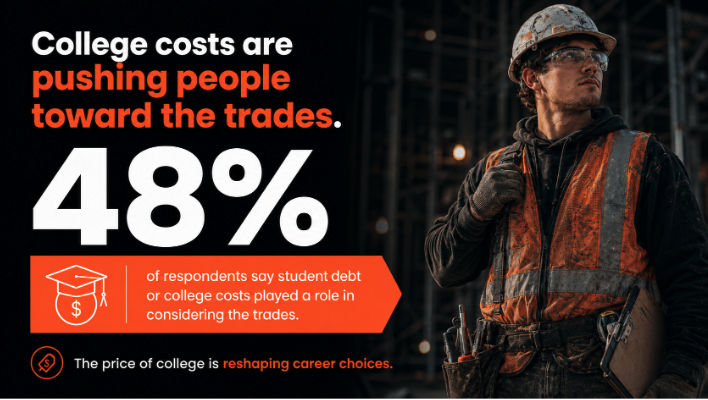
48% of respondents say student debt or college costs have played a role in pushing them toward considering trades. 13.8% call it the main reason. Among Millennials, the generation that took on the most debt and saw the slowest wage growth, 45.9% factor it in. Among Black respondents, it's 50.8%.
The macro picture confirms the shift. Soaring college tuition costs, $1.8 trillion in student loan debt and growing AI disruption of white-collar professions are all reshaping career decisions, and enrollment in community colleges has risen 12% over the past five years, with trades-related majors among the fastest-growing disciplines.
What's notable is how few people lead with debt as their motivation. Most cite security, meaning, or independence first. But debt sits underneath every conversation, the silent variable that's already changed the answer.
The Prestige Problem Is Real
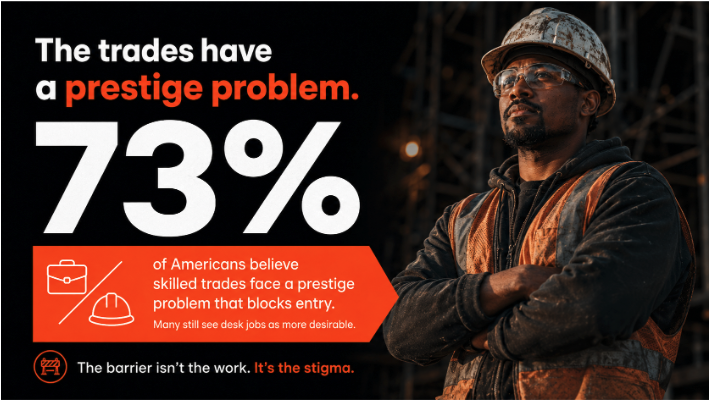
73% of Americans believe skilled trades suffer from a prestige problem that actively blocks entry, as people mistakenly think that skilled trades are not as good as desk jobs. Among Gen Z, that figure jumps to 87.9%. Among postgraduate professionals, the most credentialed Americans in the survey, 80.8% agree.
The prestige problem refers to the negative connotation people have of trade jobs. This can be due to outdated cultural stigma, pressure to attend a four-year university, and the stereotype that manual labor requires “less intelligence.” These perceptions are changing, though, as demand continues to climb for trade jobs. Additionally, celebrities like Mike Rowe and social media platforms help to shed light on the necessity of trade jobs in society.
That last number (80.8% of postgraduates) is the one to sit with. The people the formal education system has rewarded most are also the ones who most acutely feel the cultural penalty attached to trades work. While they believe in the trades, they don’t believe their social circle would.
39.7% of respondents say their friends and family would be "supportive but secretly surprised" if they entered a trade. Another 14% expect their circle to think they were settling. Career decisions are rarely made in isolation. They're filtered through what people imagine others will think, and right now, that imagined reaction is suppressing decisions the data shows are financially rational.
As one workforce analyst recently argued in The Hill, the country's stigma around blue-collar careers is no longer just a cultural inconvenience. It's an economic liability.
Day-One Pay Exists, But Nobody Knows It
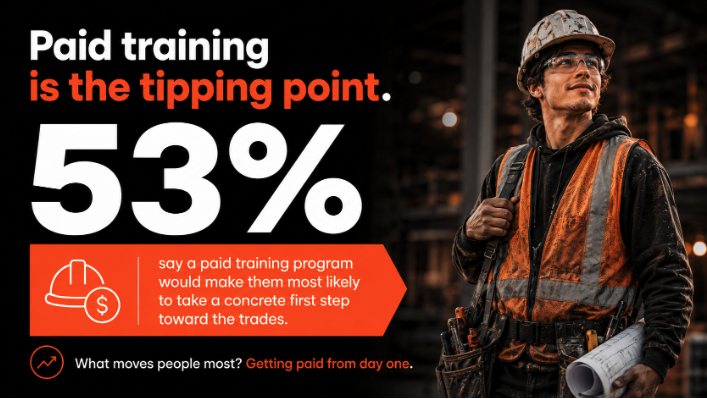
Ask Americans what would actually move them off the fence and one answer eclipses every other. 53% say a paid training program, one where they earn from day one, would make them most likely to take a concrete first step toward the trades. Among Gen Z, it's 58.1%. Among Baby Boomers eyeing a second career, 48%.
Here's the twist: registered apprenticeships in the United States already pay from day one. Apprentices earn a wage while they train, with structured pay increases as they progress through the program. The model the majority of Americans say would unlock their interest is the model the industry has been running for decades.
The Gen Z number sharpens the point. This is the generation most convinced the trades have a prestige problem (87.9% agree it actively blocks entry), and also the generation most likely to act if the financial picture is clear. The cultural skepticism doesn't disqualify the trades for Gen Z. It sets a condition. The same generation also asks for something the industry rarely advertises clearly: 54.1% of Gen Z respondents named clear, transparent salary information at each career stage as their top motivator. They watched the college ROI argument fall apart in real time. They want a spreadsheet, not a pep talk.
The two findings together point to a quieter conversion path than most workforce coverage assumes. The most powerful motivator in the study, paid training from day one, is something the trades pipeline already delivers. The most underused asset in the trades industry is its own pay story. Career changers in their 30s and 40s, the cohort respondents named as the most blocked, aren't being asked to walk away from a paycheck, since apprenticeships in the trades are fully paid. They just don't know that yet.
The good news is that the market is responding. BlackRock's $100 million Future Builders initiative, federal grants supporting apprenticeship and skills training programs and state-level commitments across California, Maryland and Massachusetts all point to a growing recognition that cash flow is the bottleneck, not curiosity.
Summary
For years, the skilled trades crisis was told as a story of disinterest. That framing has been shifting, and this survey makes clear what the new story actually is: a story of friction. The interest exists. The conversion doesn't.
Nearly half the country has imagined a different career path. A third want it for reasons that have nothing to do with desperation. They want stability, they want work that AI can't replace, they want a profession that won't disappear in the next layoff cycle. They're asking the industry to point them toward the door, not to convince them.
For employers, the implication runs in parallel. The 600,000 unfilled jobs aren't waiting on a workforce that doesn't exist. They're waiting on infrastructure that can connect builders to the candidates already raising their hands. The companies that crack the access problem first won't just fill roles faster. They'll define what construction hiring looks like for the next decade.
A working on-ramp wouldn't require reinventing the trades. It would require fixing three things the data already names: a discovery layer that meets people at the moment of curiosity instead of leaving them to navigate alone, transparent salary information that corrects the perception gap pricing millions out of their own consideration, and clearer public communication about apprenticeships, including the paid-from-day-one structure most Americans don't realize already exists.
The country has the workforce already. What it lacks is the on-ramp. Whoever builds it first will be the one shaping how the next generation of Americans defines a stable career.
Methodology
To understand how Americans approach the skilled trades, we surveyed 1,000 adults across the country. Participants answered a series of questions about their interest in trade careers, the motivations driving that interest, the barriers preventing them from taking action, and what changes to the trades pipeline would most likely move them off the fence. Responses were analyzed by demographic groups, including age, gender, income, education, ethnicity, and parental status, to identify trends and disparities.
Fair Use Policy
Users are welcome to utilize the insights and findings from this study for noncommercial purposes, such as academic research, educational presentations, and personal reference. When referencing or citing this article, please ensure proper attribution to maintain the integrity of the research. Direct linking to this article is permissible, and access to the original source of information is encouraged.
For commercial use or publication purposes, including but not limited to media outlets, websites, and promotional materials, please contact the authors for permission and licensing details. We appreciate your respect for intellectual property rights and adherence to ethical citation practices. Thank you for your interest in our research.